


By Taibat Ummi Yakubu
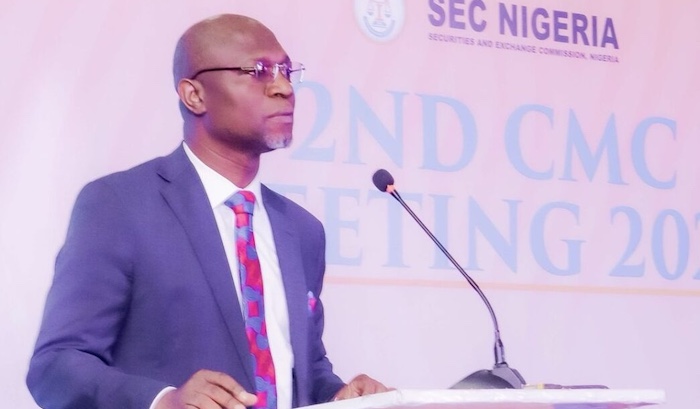
The Director-General of the Securities and Exchange Commission (SEC), Dr Emomotimi Agama, has challenged Nigerian universities to stop relying heavily on government funding and begin using the capital market to finance their development, expand infrastructure and build long-term financial independence.
Agama said universities could unlock substantial funding by investing in financial instruments, attracting private investors and turning their assets into sustainable sources of revenue rather than depending almost entirely on government allocations and occasional donations.
He made the call at the University of Ibadan Alumni Association’s Annual Public Service Lecture held in Ibadan over the weekend. The lecture, themed “First and Best But Whose Capital Built It? Rethinking How Nigeria Funds Its Own Future,” examined how the country could mobilise domestic resources to finance education and national development.
Using the University of Ibadan as a case study, Agama recalled that the institution’s establishment in 1948 was supported by a major land donation from the chiefs and people of Ibadan, who provided 2,500 acres under a 999-year lease.
He noted that although the university had produced a Nobel laureate, heads of state, central bank governors and influential figures in Nigeria’s financial sector, it had yet to approach the capital market to raise long-term funding for its operations and development.
“Not once. Not a bond. Not a fund. Not a listed vehicle,” Agama said, describing the situation as a missed opportunity for an institution whose graduates had helped build the very financial market it could now use to secure its future.
According to him, continued dependence on government appropriations is becoming increasingly difficult to sustain amid the country's fiscal challenges, making it necessary for universities to explore alternative funding models that can generate income over time.
He highlighted the scale of the university’s infrastructure challenges, noting that it has approximately 41,700 students, while its halls of residence were designed to accommodate fewer than 10,000. The shortfall has left thousands of students dependent on off-campus accommodation, much of it provided by private landlords.
Agama argued that Nigeria’s challenge was not necessarily a shortage of capital but the failure to channel available funds into productive investments capable of generating long-term economic and social benefits.
He cited pension assets of N31.48 trillion as of July 2026 and Nigerian Exchange market capitalisation of N215.09 trillion as evidence of the financial resources available within the domestic economy.
He also compared the N4.65 trillion raised by banks over 24 months through recapitalisation with the N2.53 billion allocated to a university by the Tertiary Education Trust Fund (TETFund), a difference of roughly 1,000 to one.
For Agama, the figures demonstrate the capacity of the capital market to mobilise substantial long-term funding, provided institutions develop credible projects and structures that investors can trust.
Five ways universities can unlock capital
To help universities reduce their dependence on government funding, the SEC director-general outlined five financing options that the University of Ibadan could explore under the Investments and Securities Act 2025.
His first proposal was the establishment of a properly structured endowment fund registered with the SEC as a collective investment scheme. Such a fund, he explained, could operate with an independent trustee, a licensed fund manager and a spending policy that limits annual withdrawals to between four and five per cent, allowing the principal to grow over time.

Second, he proposed that universities issue bonds or sukuk through dedicated financing vehicles backed by clearly identified assets capable of generating revenue. Such arrangements could help institutions raise funds for major projects while establishing defined sources of repayment.
Student accommodation, however, emerged as one of the most immediate opportunities for investment. Agama suggested that the University of Ibadan could use a Real Estate Investment Trust (REIT) or concession arrangement to develop additional housing and convert rental payments currently flowing to private landlords into a potential revenue stream for the institution.
He also called for the creation of university innovation funds that would invest in companies emerging from research laboratories. Under this arrangement, universities could take equity stakes in start-ups commercialising their research, enabling them to benefit financially from innovations developed within their institutions.
The fifth proposal involved creating an investment instrument targeted at Nigerians living abroad. Using the non-resident Bank Verification Number (BVN) framework, Agama said universities could attract part of the estimated $21.8 billion in annual remittances into productive investments rather than leaving the money primarily directed towards consumption.
Financial discipline is key to attracting investors
Despite the opportunities, Agama warned that access to capital market funding would require universities to demonstrate strong financial management, transparency and accountability.
He said institutions seeking investors must publish audited financial statements annually, obtain credit ratings from registered agencies where required, establish dedicated revenue streams that remain viable despite changes in leadership, and engage qualified financial professionals to structure and manage their investments.
He also urged university alumni to reconsider how they support their former institutions, arguing that donations spent immediately may provide short-term relief but do not necessarily create lasting financial resources.
Instead, he proposed an Alumni Capital Fund with a low minimum investment threshold, enabling young graduates and Nigerians in the diaspora to contribute to an investment pool that could grow over time.
The proposed fund, he said, should operate under transparent governance arrangements and publish audited accounts annually to build investor confidence and ensure accountability.
In his remarks, the Acting President of the University of Ibadan Alumni Association, Professor Terrumun Gajir, stressed the need for Nigeria to strengthen domestic investment and reduce excessive dependence on external sources of capital.
He said achieving this goal would require the country to mobilise pension funds, household savings and private-sector resources towards productive investments that support national development.
Earlier, the chairman of the occasion, Bayo Oyero, urged the University of Ibadan to move beyond the traditional activities of its alumni association and begin investing directly in financial markets.
The proposals have placed a fresh spotlight on how Nigerian universities can finance expanding student populations, address infrastructure gaps and secure more predictable funding. For institutions facing mounting demands and limited public resources, the central challenge is whether they can build the financial discipline and investment structures needed to turn their assets, research and alumni networks into sustainable sources of income.


Comments (0)
No comments yet. Be the first to share your thoughts!