


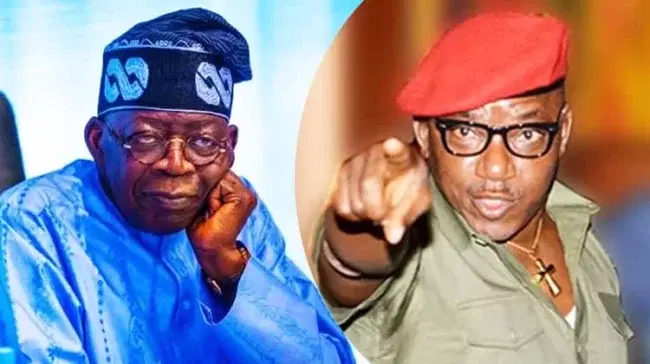
Former Minister of Youth and Sports, Solomon Dalung, has reignited the controversy surrounding President Bola Ahmed Tinubu’s prolonged absence from Nigeria, accusing the President of failing to follow the constitutional procedure for transferring presidential authority to Vice President Kashim Shettima.
Dalung made the allegation on Monday during an appearance on Daily Trust’s News Hour, where he questioned the legality of the Presidency’s description of Tinubu’s trip as a “working vacation.”
According to him, the Nigerian Constitution makes no provision for such a phrase and cannot be altered by a government statement.
Dalung argued that the real issue was not whether Tinubu had continued to perform official duties from abroad, but whether the constitutional requirements governing a President’s absence had been fulfilled.
“The Nigerian President proceeded on vacation. It was announced that he was going on a working vacation. The concept of working vacation is incongruous and unknown in our Constitution,” he said.
“There is nothing called working vacation or working leave. The Constitution does not recognise that. The media or the press cannot amend the Constitution of Nigeria with a press statement.”
The former minister maintained that Section 145 of the 1999 Constitution clearly sets out what should happen when the President proceeds on vacation or is unable to perform the functions of his office.
He said the provision was intended to prevent any uncertainty over the exercise of presidential authority, insisting that the length of the President’s absence should not determine whether the constitutional procedure applies.
“The issue here is not that the absence of the President has affected anything. It is a constitutional issue which is dealt with in Section 145 subsection 1,” Dalung said.
“The rule is clear. When the President proceeds on vacation, whether it is a one-day vacation or five minutes vacation, the Constitution requires that a vacuum will not exist at all.”
According to Dalung, once a President formally proceeds on leave, the Constitution requires him to transmit authority to the Vice President.
He particularly drew attention to the word “shall” in the constitutional provision, arguing that it makes the requirement mandatory rather than optional.
Dalung also turned his attention to the National Assembly, questioning why lawmakers had not taken action under Section 145(2), which provides a mechanism for the Vice President to assume presidential functions when the President fails to transmit the required declaration within 21 days.

“The conversation should be why has the President failed to comply with Section 145 subsection 1 of the Constitution and why has the National Assembly failed to comply with Section 145 subsection 2,” he said.
Tinubu departed Nigeria on August 30 for a three-week trip to Europe, which the Presidency described as a working vacation. His stay was subsequently extended by several days, with the Presidency indicating that he was expected back in the country at the weekend.
The President’s absence has since generated a fresh constitutional debate, particularly over whether a President can continue to exercise full presidential powers from abroad without formally transmitting authority to the Vice President.
Senate President Godswill Akpabio has, however, dismissed suggestions that Nigeria is facing a leadership vacuum.
Akpabio maintained that Tinubu remains in charge of the country and continues to conduct government business despite being outside Nigeria. He also rejected the suggestion that he had become Acting President.
But Dalung was not convinced.
He said Nigerians deserved more detailed information about the President’s whereabouts and official engagements while he remains outside the country.
“We have to depend on the state press media to give us transparent information of the President’s whereabouts and what he is doing, and must be accountable for where the President is,” he said.
“But as it is, they are economical with the truth. Nigerians need to know where their President is and what he is doing.”
Dalung further criticised the National Assembly for what he described as its failure to exercise its constitutional responsibility over the matter.
For the former minister, the controversy is bigger than Tinubu’s current trip. He argued that it raises fundamental questions about constitutional compliance and the limits of executive authority.
He concluded by accusing both the executive and legislature of failing to uphold the spirit of Nigeria’s democratic system, describing the situation as “democratic anarchy with impunity” under the Constitution of the Federal Republic of Nigeria.



Comments (0)
No comments yet. Be the first to share your thoughts!