


TAIBAT UMMI YAKUBU
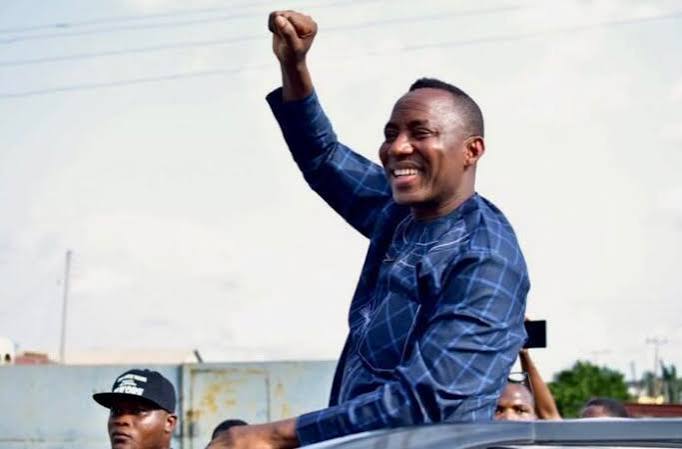
The Department of State Services (DSS) has asked the Federal High Court in Abuja to stop human rights activist and former presidential candidate Omoyele Sowore from presenting further evidence in his ongoing cyberbullying trial, accusing him of repeatedly delaying proceedings beyond the limits allowed by law.
The request could significantly alter the direction of the trial, as the security agency is seeking to have Sowore's defence formally closed before the conclusion of his case.
DSS counsel, Akinlolu Kehinde, a Senior Advocate of Nigeria (SAN), brought the application to the attention of Justice Mohammed Umar on Tuesday, shortly before the court adjourned.
Kehinde argued that Sowore had exhausted the number of adjournments permitted under the Administration of Criminal Justice Act (ACJA), 2015, and had exceeded the statutory limit by nine occasions.
He insisted that the proceedings could not continue indefinitely and urged the court to consider the application already filed by the prosecution.
“Before we finally draw the curtain to the proceedings, I want to bring to your lordship's notice the application we filed and served on the defendant.
“The application is that there must be an end to all these. The defendant has since exceeded the number of adjournments as required by law,” he told the court.
The DSS had filed the motion on notice on November 23, seeking two major orders: an order closing Sowore's defence and a directive requiring both parties to submit and exchange their final written addresses within a timeframe to be determined by the court before fixing a date for their adoption.
In support of its request, the security agency presented a nine-ground argument, claiming that Sowore had sought or obtained at least 14 adjournments since his arraignment in the case.
According to Kehinde, eight of those adjournments occurred after the activist was asked to open his defence.
He explained that Sowore was re-arraigned on a two-count charge on January 19, to which he pleaded not guilty, paving the way for the commencement of the trial.
The prosecution subsequently presented its witness and closed its case in March 2026. Sowore's no-case submission was dismissed by the court on May 8, after which he was directed to enter his defence.
However, Kehinde argued that the trial had made little progress since then, despite several opportunities given to the defendant to present his case.
He told the court that Sowore opened his defence on July 6, 2026, but proceedings had advanced only to the testimony of two defence witnesses.
The DSS maintained that this amounted to an abuse of the adjournment provisions under Section 396(4) of the ACJA, which it argued limits each party to five adjournments during criminal proceedings.
The prosecution also accused Sowore of repeatedly filing applications and other court processes that had contributed to delays, including proceedings surrounding the subpoena issued to the lead counsel for the complainant.
Kehinde further argued that the court had previously cautioned the defence against actions capable of prolonging the trial.
He maintained that the constitutional right to a fair hearing should not be interpreted as permission for defendants to seek unlimited adjournments.
According to him, Section 36 of the Constitution guarantees every defendant an opportunity to present a defence within a reasonable time, while the ACJA requires criminal proceedings to be conducted expeditiously.
He therefore urged Justice Umar to grant the application in the interest of justice, arguing that Sowore had already been given sufficient opportunity to defend himself.
But Sowore's legal team opposed the move, insisting that the court must first determine other pending applications before considering the DSS request to close their defence.
His counsel, Reuben Adakole, confirmed that they had received the prosecution's application but argued that it was premature because the court was yet to rule on objections raised by the Chairman of the Independent National Electoral Commission (INEC), Prof. Joash Amupitan, SAN, over the subpoena issued to him.
Adakole also referred to their preliminary objection and an ex-parte application, insisting that the pending matters should be resolved before the prosecution's request could be entertained.
“In as much as the application tends to foreclose us, there is our application which the court ought to pronounce on first. Until after the ruling, we can look at it. The application is unripe, my lord,” he argued.

The disagreement over the subpoena also featured prominently during Tuesday's proceedings, with both legal teams presenting opposing interpretations of why Amupitan had been summoned.
Earlier in the hearing, Alex Iziyon, SAN, who represented the INEC chairman, informed the court that the matter had been adjourned the previous day because Sowore's legal team had not filed its counter-affidavit.
He said the defence had since submitted the document and that INEC had also responded, urging the parties to adopt their respective court processes.
Adakole confirmed that the documents had been exchanged but maintained that the subpoena issued to Amupitan was strictly a subpoena duces tecum, meaning the INEC chairman was required to produce specified documents rather than appear as a witness to give oral testimony.
He explained that Sowore was not seeking to compel Amupitan to testify in court but only wanted him to produce documents in INEC's custody that could be relevant to his defence.
“It is just strictly to come and tender the documents and that was why we filed a motion to amend the application,” Adakole said.
He subsequently asked the court to allow him to move an ex-parte application, arguing that doing so would help resolve the disagreements surrounding the subpoena.
However, Iziyon rejected the explanation, accusing the defence of attempting to disregard the court's earlier directive.
He reminded the judge that the defence had previously been instructed to formally serve its application on the other parties to allow them to respond.
“The defendant cannot take this court for a ride. I submit with all sense of responsibility,” Iziyon told the court.
Justice Umar also reminded Adakole that once the parties had joined issues on the matter, any further request would have to be made through a motion on notice and served on the opposing parties.
The judge directed the defence to comply with the procedure, following which Adakole agreed to proceed with the pending applications.
Adopting INEC's processes, Iziyon urged the court to set aside the subpoena, relying on an earlier ruling by Justice Umar concerning the court's authority to invalidate such orders.
He also cited a previous judicial decision in which a subpoena was set aside because the case had no connection with the person who was being summoned.
Iziyon urged the judge to carefully examine the arguments presented, maintaining that any attempt to amend the application should first receive the court's approval.
Adakole, in response, adopted the defence processes and asked the court to dismiss INEC's application challenging the subpoena.
He also moved an ex-parte application filed on November 11, seeking four reliefs from the court.
Explaining the purpose of the application, the lawyer said the subpoena was directed at a public officer who had custody of government documents needed by Sowore to establish his defence.
He argued that the relevance of the documents could only be determined after they had been produced before the court, rather than being dismissed in advance.
“It is not for the applicant to say so. That will be preemptive,” he submitted.
After hearing the parties, Justice Umar adjourned the case until December 7 for a ruling on Amupitan's application seeking to set aside the subpoena.
The date will also be used to hear the DSS application seeking to close Sowore's defence, alongside other pending applications in the case.
The outcome of the proceedings could determine whether Sowore will be allowed to continue presenting witnesses and evidence or whether the court will direct the parties to move towards final written addresses in the cyberbullying trial.
.jpg)

Comments (0)
No comments yet. Be the first to share your thoughts!