


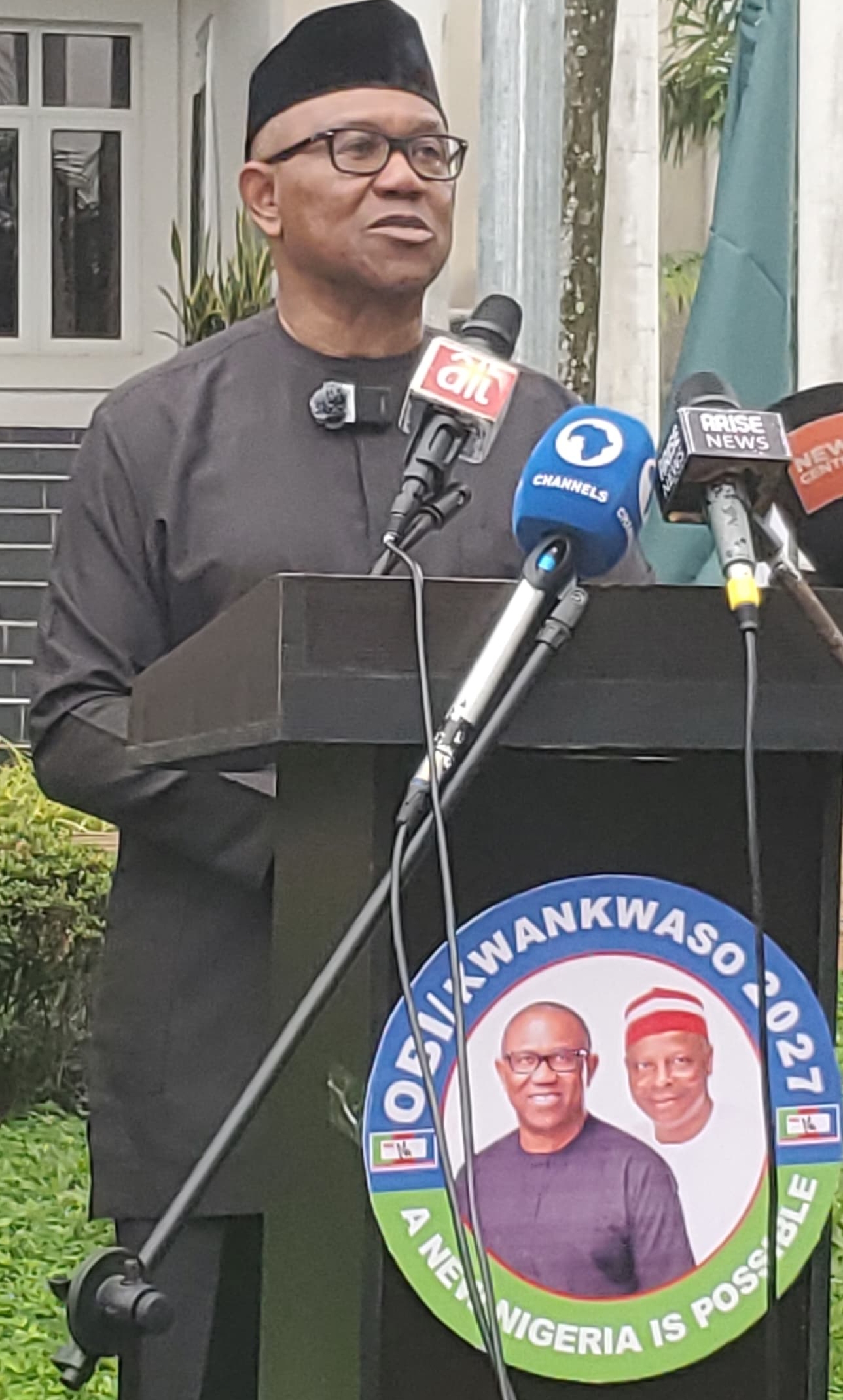
The battle for Nigeria’s highest office gathered fresh momentum on Friday as the presidential candidate of the Nigerian Democratic Congress (NDC), Peter Obi, officially launched his campaign for the 2027 general election, unveiling an ambitious blueprint aimed at tackling the country’s economic and security challenges.
Speaking at a press conference in Onitsha, Anambra State, Obi formally flagged off his campaign activities ahead of the January 16 presidential and National Assembly elections, using the occasion to appeal directly to Nigerians for their support and mandate.
The former Anambra governor described the coming election as a defining moment for the nation, arguing that Nigeria stands at a critical crossroads and requires purposeful leadership capable of reversing years of economic hardship, insecurity, and declining public confidence.
According to him, despite the difficulties confronting the country, he remains convinced that Nigeria can still achieve its vast potential if its resources are managed effectively and its people are placed at the centre of governance.
Obi said his decision to seek the presidency was driven by a commitment to confront the pressing issues affecting millions of Nigerians, particularly unemployment, poverty, weak infrastructure, and the rising cost of doing business.
He noted that every year, millions of young Nigerians enter the labour market only to face limited opportunities, a situation he said has contributed to growing frustration among the country's youthful population.
Painting a picture of his economic agenda, Obi pledged to prioritise production, investment, entrepreneurship, and human capital development if elected. He argued that sustainable economic growth can only be achieved through policies that encourage productivity and create opportunities for businesses to thrive.
The NDC candidate maintained that his record in both the private and public sectors has equipped him with the experience needed to lead Africa’s most populous nation. He cited his tenure as governor of Anambra State, as well as his exposure to global institutions focused on business and public policy, as evidence of his preparedness for the task ahead.
Obi also highlighted the credentials of his running mate, Senator Rabiu Musa Kwankwaso, describing him as a seasoned administrator whose contributions to education, skills acquisition, infrastructure, and human capital development during his time as governor of Kano State remain noteworthy.
According to Obi, while their leadership experiences were shaped by different circumstances, both men share a common belief that a nation’s greatest asset is its people and that public resources must be managed with prudence and accountability.
Reflecting on his time in office, Obi said his administration in Anambra concentrated on strengthening critical sectors such as education, healthcare, infrastructure, and institutional development, laying foundations for long-term growth rather than pursuing short-term political gains.
As campaigns begin to gather pace nationwide, the former governor urged Nigerians to critically evaluate all candidates seeking public office. He called on voters to scrutinise records, question campaign promises, and demand evidence-backed solutions rather than rhetoric.
He further appealed for peaceful and issue-based campaigns, stressing that political competition should not undermine national unity or trigger violence.
In outlining his plans for the agricultural sector, Obi promised to boost food production by improving security in farming communities, expanding irrigation projects, rehabilitating rural roads, and providing farmers with better access to financing and markets.
He added that an Obi-Kwankwaso administration would focus on strengthening manufacturing and agro-processing industries to enable Nigeria to export more finished products and derive greater value from its natural resources.
The presidential hopeful also pledged to create a more business-friendly environment by reducing regulatory bottlenecks, addressing infrastructure deficits, and encouraging private-sector investment capable of generating jobs and economic growth.
On public finance management, Obi vowed to enforce fiscal discipline and ensure that government spending delivers measurable outcomes. He said every naira spent by government must serve a clear purpose and contribute meaningfully to national development.
“The objective is not merely to record economic growth figures,” he said, “but to build an economy that creates jobs, generates wealth, increases productivity, and improves the quality of life for ordinary Nigerians.”
Security, another major concern raised during the campaign launch, featured prominently in Obi’s agenda. He promised to strengthen intelligence gathering, improve coordination among security agencies, enhance border management, and deploy modern technology to combat emerging threats.
He also expressed support for lawful community-based security structures capable of identifying risks early and assisting security agencies in responding effectively.
According to him, meaningful security reforms must include greater decentralisation of security management while maintaining strong coordination among various levels of government.
Obi argued that insecurity remains one of the biggest obstacles to national development, noting that farmers cannot cultivate their lands, businesses cannot move goods, and children cannot attend school when safety is not guaranteed.
With the campaign season now officially underway, Obi’s message signals a strategy focused on economic revival, institutional reforms, and security improvements as he seeks to convince Nigerians that he and Kwankwaso offer an alternative path for the country’s future.
.jpg)

Comments (0)
No comments yet. Be the first to share your thoughts!