


By Mustafa Abubakar
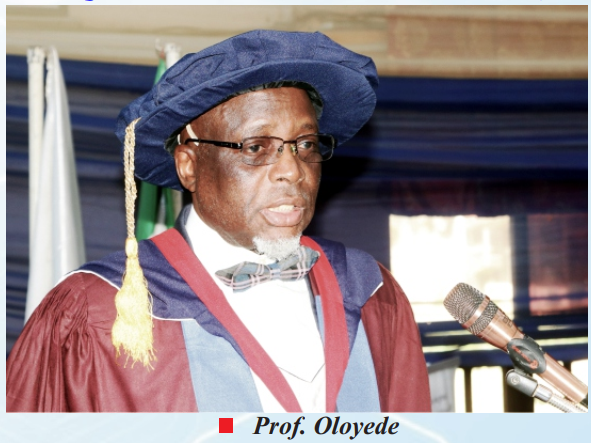
There are speeches that are delivered, speeches that are heard, and speeches that demand to be examined. Emeritus Professor Is-haq O. Oloyede’s keynote address at the 37th Annual Conference and General Assembly of the Committee of Vice-Chancellors of Nigerian Universities (CVCNU) belongs to the third category.
His address, titled “Reimagining Nigerian Universities for Resilience: Leadership, Innovation and Sustainability in a Disruptive Era,” was not simply a conversation about universities. Beneath the language of resilience, innovation, sustainability and institutional reform was a larger question: What happens when institutions refuse to change while the society around them changes?
That question is equally relevant to journalism.
And this is where Emeritus Professor Is-haq O. Oloyede’s discussion of COBESISATION becomes particularly significant.
From the Classroom to the Community
In reflecting on the transformation of university education, Emeritus Professor Is-haq O. Oloyede recalled the University of Ilorin’s decision, during his tenure as Vice-Chancellor, to extend the Community-Based Experience and Service (COBES) philosophy beyond the College of Health Sciences to virtually all academic programmes.
According to Emeritus Professor Is-haq O. Oloyede, the approach involved “shifting focus from classrooms only to community-oriented and problem-solving approach.” He described the COBESISATION of academic programmes as a model worth replicating and said it strengthened the “town and gown relationship.”
That is a powerful proposition.
But for a journalist, it immediately raises another question:
If COBES can transform the relationship between academic disciplines and society, why should journalism remain largely newsroom-bound?
That question is the beginning of this reflection.
What Does COBESISING Journalism Mean?
COBESISING journalism means moving journalism education and practice beyond routine assignments, press releases and conventional news reports into deliberate engagement with the communities journalism is expected to serve.
The journalism student should not merely learn how to write a story. The student should learn how to enter a community, listen to its people, identify a problem, investigate its causes, interrogate claims, gather evidence, give affected people a voice and communicate findings in a way that contributes to public understanding.
In journalism, therefore, COBESISING could be understood as Community-Based Experience and Service through Journalism.
The community becomes the field.
The problem becomes the story.
The investigation becomes the newsroom.
The citizen becomes a source, participant and beneficiary.
And the published story becomes more than content; it becomes an instrument of public knowledge.
From Observation to Experience
This reflection is not being made entirely from the distance of theory.
It is informed by nearly two decades of the writer’s experience covering the COBES exercises of University of Ilorin students across the Northern, Southern and Central parts of Kwara State.
For almost two decades, the writer has had the opportunity to observe, report and interact with the realities surrounding the deployment of UNILORIN students into communities.
That experience provides a practical window through which the significance of Emeritus Professor Is-haq O. Oloyede’s COBESISATION philosophy can be understood.
COBES is not simply about taking students away from the university campus. It is about taking knowledge to the people and, in return, bringing the realities of the people back into the learning environment.
For the journalist, the experience is even richer.
The journalist sees the encounter between knowledge and society, theory and practice, university and community.
The reporter can ask:
What problem brought the students to the community? What did they discover? What did the community need? What knowledge did the students bring? What did they learn from the people? What changed? What remained unresolved? And what should happen after the students leave?
These are not merely journalistic questions. They are questions of accountability, development, public service and institutional relevance.
The Classroom Was Never Meant to End There
The writer’s experience of university education provides another dimension to this reflection.
Across the different classes and courses encountered in the university, theories and concepts were taught as academic knowledge. But experience gradually demonstrates that theory acquires its fullest meaning when tested against reality.
Communication theories become clearer when one observes how people communicate, misunderstand one another, negotiate meaning and respond to different contexts.
News values become meaningful when a journalist must determine what deserves public attention.
Gatekeeping becomes visible when information has to be selected, verified and prioritised.
Framing becomes evident when the same event can be presented from different perspectives.
Agenda-setting becomes apparent when sustained attention to an issue influences what society considers important.
Interpersonal communication becomes real when people negotiate relationships, resolve disagreements and attempt to live together.
The lesson is therefore simple: academic knowledge should not remain confined to lectures and examinations. It must be tested against the realities of professional practice and human interaction.
This is the deeper value of COBES.
The community does not replace the university.
It extends the university.
The field does not destroy theory.
It tests theory.
And the people do not merely receive knowledge.
They also possess knowledge.
The Community Begins at Home
The practical meaning of communication does not end with journalism or community reporting. It extends into the home and family.
The home itself is a community.
The relationship between husband and wife is a living communication environment. Two people may enter marriage with different backgrounds, expectations, experiences and interpretations of responsibility. What appears simple in theory can become complex in practice.
There must be listening.
There must be empathy.
There must be negotiation.
There must be context.
There must be the ability to distinguish between what is said and what is actually meant.
And there must be an understanding that winning an argument is not necessarily the same as solving a problem.
The same principles apply to parents and children, relatives, neighbours, community leaders, religious institutions, professionals and other stakeholders.
Communication is not simply about sending a message. It is about meaning, context, relationships, power, interpretation and consequence.
That is why the theories learned in university are not confined to the lecture room. They reappear in journalism, community relations, family relationships and everyday human interaction.
The classroom, the newsroom, the community and the home are therefore connected by one fundamental reality: people must communicate if they are to understand one another.
Who, When, Where and Why?
Who should COBESISING journalism concern?
First, the journalism student. But it cannot end there. It should involve journalism departments, universities, media organisations, editors, reporters, regulators, civil society organisations, communities and the public.
The journalist is a knowledge producer.
The audience is a user.
The community affected by an issue is a stakeholder.
When these three are disconnected, journalism risks becoming narration without consequence. When they are connected, journalism becomes public service.
When should journalism be COBESISED?
Now.
Journalism is facing the same disruption confronting universities: artificial intelligence, digital platforms, changing audience behaviour, misinformation and declining public trust.
Emeritus Professor Is-haq Oloyede argues that institutional assessment itself must change, with greater attention to reasoning, application, evidence, field engagement and ethical judgement.
The implication for journalism is clear. If training remains disconnected from the realities of professional practice, we risk producing journalists prepared for a world that no longer exists.
Where should COBESISING journalism take place?
Everywhere journalism matters: rural communities, urban centres, schools, hospitals, markets, farms, government institutions and digital spaces.
The journalist must be where the people are.
And increasingly, the journalist must be where the evidence is.
Why?
Because journalism exists for society.
Journalism tests claims, questions power, preserves public memory, exposes contradictions, gives visibility to neglected communities and connects citizens with institutions.
This closely parallels Emeritus Professor Is-haq Oloyede’s description of the university as “society’s organised capacity for critical intelligence.”
The Distinctive Journalistic Questions
The traditional questions remain fundamental:

WHAT happened?
WHO is affected?
WHEN did it happen?
WHERE is it happening?
WHY is it happening?
But COBESISING journalism requires the journalist to go further:
WHO benefits?
WHO loses?
WHO has the power to change it?
WHO has been ignored?
WHAT evidence exists?
WHAT has been promised?
WHAT has actually been done?
WHY has the problem persisted?
WHAT happens if nothing changes?
And perhaps the most important:
WHAT CAN BE DONE DIFFERENTLY?
This is where journalism becomes more than reporting.
It becomes analysis.
It becomes accountability.
It becomes public intelligence.
The Pain: When Journalism Is Bastardised
This is where the painful part of the reflection comes in.
From the perspective of someone who has experienced journalism both as a professional practice and through academic study, it is difficult not to observe that many aspects of journalism appear increasingly bastardised—detached from the discipline, ethics, intellectual foundations and social responsibility that ought to define the profession.
News can become a race for clicks.
Reporting can become copying.
Analysis can become opinion without evidence.
Verification can be sacrificed for speed.
A headline can become more important than the substance beneath it.
Social media claims can be treated as news before adequate interrogation.
Commercial and political interests can compete with editorial judgement.
Technology can make production faster while simultaneously weakening reflection.
This is why the classroom matters.
Theories are not ornaments.
Ethics are not decorations.
News values are not obsolete rules.
Verification is not an inconvenience.
Interviewing is not merely asking questions.
Writing is not merely arranging words.
The education of a journalist should provide the intellectual discipline necessary to distinguish information from evidence, assertion from fact, publicity from journalism and noise from knowledge.
COBESISING journalism therefore does not mean abandoning the classroom.
It means taking what is learned there into the newsroom and then testing it in the community.
The Journalist as a Bridge
The COBES model suggests a different understanding of the journalist’s role.
The journalist should not merely stand outside the community as an observer. Neither should the journalist become an activist who abandons professional distance.
The journalist should become a bridge:
A bridge between the university and the community.
A bridge between knowledge and lived experience.
A bridge between evidence and public understanding.
A bridge between those who make decisions and those who live with their consequences.
That requires professional independence, ethical discipline, accuracy, evidence and curiosity.
It requires the willingness to go beyond the first answer.
What Happens If We Refuse to Change?
There is a warning embedded in Emeritus Professor Is-haq Oloyede’s analysis.
Inherited arrangements must be transformed when they no longer serve the public good. Reimagining must produce actual changes in decisions, systems and relationships rather than another declaration that disappears after a ceremony.
The message is particularly clear: universities should move from slogans to concrete commitments, measurable action and accountability.
That principle applies equally to journalism.
Institutions do not always decline because nobody warned them.
Sometimes they weaken because people heard the warning and refused to act.
Sometimes the problem is not lack of information but refusal to accept information.
Sometimes people have ears but choose not to listen.
And when evidence is rejected, facts are displaced by convenience.
When analysis is dismissed, noise takes the place of knowledge.
And when serious ideas are ignored, nonsense is given the opportunity to become policy, culture or public opinion.
That is precisely why journalism matters.
The journalist’s responsibility is not to flatter the powerful, nor to attack the powerful merely because they are powerful.
The responsibility is to interrogate facts, follow evidence and ask the questions others may prefer not to hear.
The Change That Cannot Be Avoided
The central philosophy of Emeritus Professor Is-haq Oloyede’s CVCNU address can therefore be reduced to a simple proposition:
The environment has changed, and institutions must change with it.
The address points towards redesigned assessment, stronger research, community engagement, responsible digital transformation, collaboration and the replacement of obsolete routines with systems capable of responding to contemporary realities.
Journalism cannot be exempt.
If journalism refuses to change, journalism itself will be changed—by technology, artificial intelligence, social media, audiences, misinformation and new forms of information production.
The choice, therefore, is not whether journalism will change.
The choice is whether journalists will lead the change or merely report it after it has happened.
For Those Who Have Ears
Perhaps the final lesson is not only for universities or journalism schools. It is for anyone who has the opportunity to hear, understand and act.
Emeritus Professor Is-haq Oloyede has provided an intellectual framework for reimagining institutions. His COBESISATION experience demonstrates that education can move beyond institutional walls and become directly connected to society. His wider argument is that innovation should solve real problems, research should produce public value, community engagement should be embedded in institutional life, and reimagining should ultimately produce measurable change.
For journalism, the message should be unmistakable:
Do not merely teach students to report the world. Teach them to understand it. Do not merely send them into communities to collect stories. Send them to understand problems. Do not merely ask what happened. Ask why it happened, who is affected, who is responsible, who benefits, who is excluded and what can be done.
After nearly two decades of watching UNILORIN students carry university knowledge into communities across the Northern, Southern and Central parts of Kwara State, the writer’s experience suggests that the same philosophy can offer journalism a way to reconnect its theory, practice and public purpose.
And perhaps that is the real meaning of COBESISING JOURNALISM: carrying journalism beyond the newsroom and into the heart of the communities it is meant to serve.
That is not merely a question for journalism educators. It is a question for journalism itself. And to those who have heard but have refused to listen: A society cannot permanently silence evidence. It can only postpone the consequences of ignoring it. Reimagining is not a slogan. Change is not optional. And those who have ears should hear.
Mustafa Abubakar is an Assistant Director, Information, University of Ilorin, and former Vice Chairman of the Nigeria Union of Journalists (NUJ).

.jpg)

Comments (0)
No comments yet. Be the first to share your thoughts!