


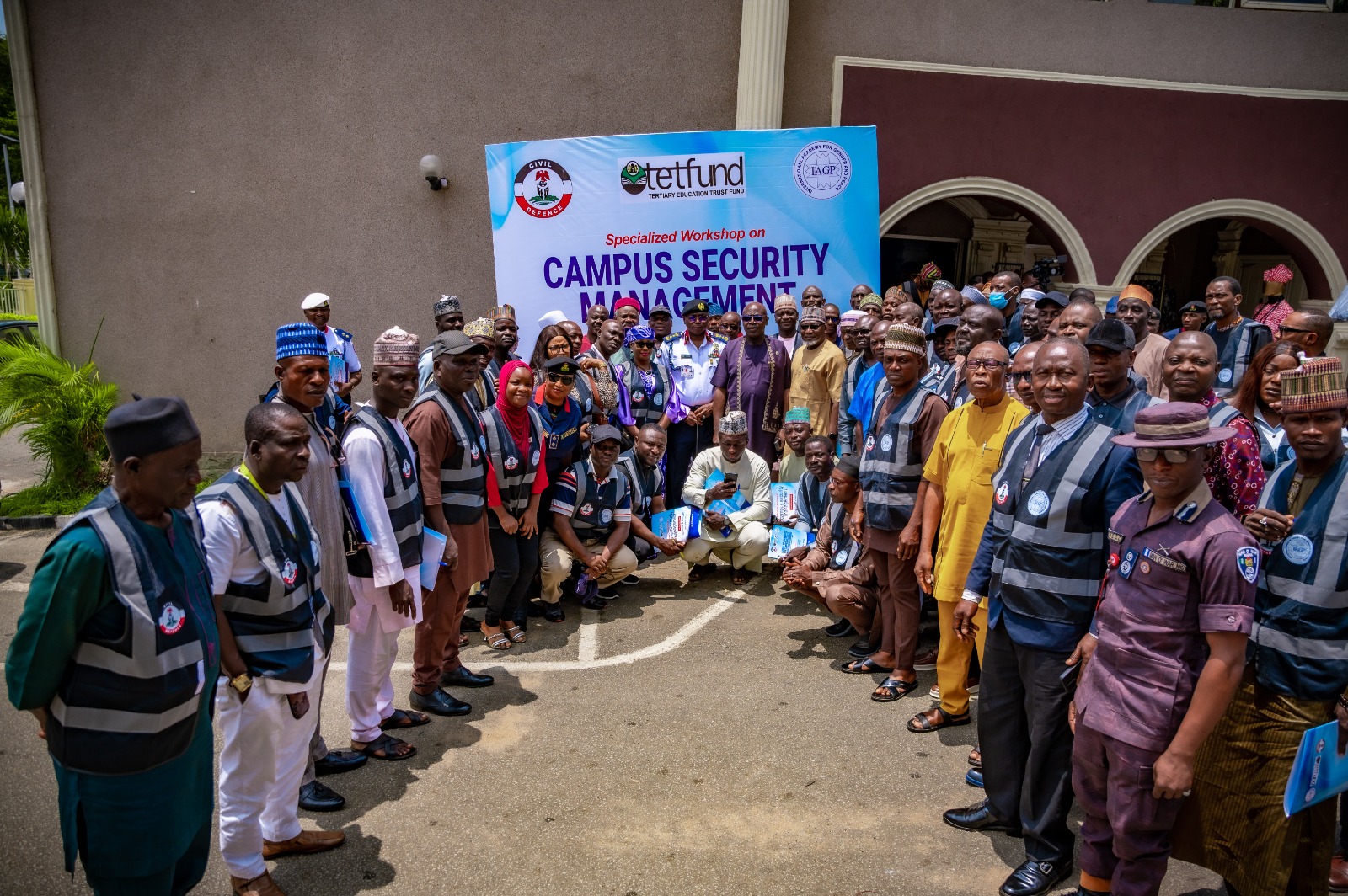
The Nigeria Security and Civil Defence Corps (NSCDC) has joined forces with the Tertiary Education Trust Fund (TETFund) and the International Academy for Gender and Peace (IAGP) to strengthen security architecture across Nigeria’s tertiary institutions amid growing concerns over safety on campuses.
The partnership was unveiled in Abuja on Tuesday during the opening of a four-day specialised workshop on Campus Security Management (CSM) organised for 600 Chief Security Officers (CSOs) drawn from tertiary institutions across the 36 states and the Federal Capital Territory (FCT).
Speaking at the event, the Commandant General of the NSCDC, Prof. Ahmed Audi, said the training became necessary in view of the increasing security challenges confronting higher institutions nationwide.
According to him, tertiary institutions are increasingly facing threats ranging from cult-related activities and violent extremism to kidnapping, cybercrime, drug abuse, gender-based violence and campus unrest.
Audi warned that the security challenges affecting communities across the country were gradually finding expression within academic environments, making it imperative for campus security personnel to remain proactive and prepared.
He noted that some individuals who later became involved in serious criminal activities, including banditry and kidnapping, had reportedly begun their criminal engagements while on campuses.
The NSCDC boss therefore urged Chief Security Officers to strengthen surveillance, embrace intelligence-driven security strategies and continuously update their knowledge to effectively tackle emerging threats.
He stressed that security personnel must remain vigilant and committed to protecting lives and property while also respecting the rights and freedoms of students, lecturers and other members of the academic community.
“As security threats continue to evolve, campus security officers must equally evolve in their methods and approaches to safeguarding educational institutions,” he said.

In his remarks, the Course Director and President of the International Academy for Gender and Peace, Prof. Frederick Tyoor, said the workshop was designed to equip security officers with modern techniques for identifying risks and addressing vulnerabilities before they escalate into major security incidents.
Tyoor emphasised the critical role of intelligence gathering in campus security management, noting that timely and accurate information remains one of the most effective tools for preventing crime and maintaining peace within academic institutions.
According to him, proactive intelligence can help security personnel detect threats early, enabling authorities to respond before situations deteriorate.
Also speaking, Dr. Yusuf Gamawa, who represented the Executive Secretary of TETFund, Arc. Sonny Echono, reaffirmed the agency’s commitment to initiatives that promote safe and conducive learning environments across tertiary institutions.
He said ensuring security on campuses remains essential to achieving quality education and creating an atmosphere where students and academic staff can thrive without fear.
A goodwill message was delivered by Prof. Bilyaminu Muhammed, a Professor of Demography and Industrial Sociology at Nasarawa State University, Keffi, who highlighted the importance of collaboration among security agencies, educational institutions and policymakers in addressing emerging security concerns.
The four-day workshop brings together experts from academia and various security agencies to expose participants to contemporary approaches, strategies and best practices in campus security management.
Organisers expressed optimism that the training would strengthen the capacity of Chief Security Officers to anticipate, prevent and effectively respond to security threats, ultimately contributing to safer and more secure learning environments across Nigeria’s tertiary institutions.



Comments (0)
No comments yet. Be the first to share your thoughts!