


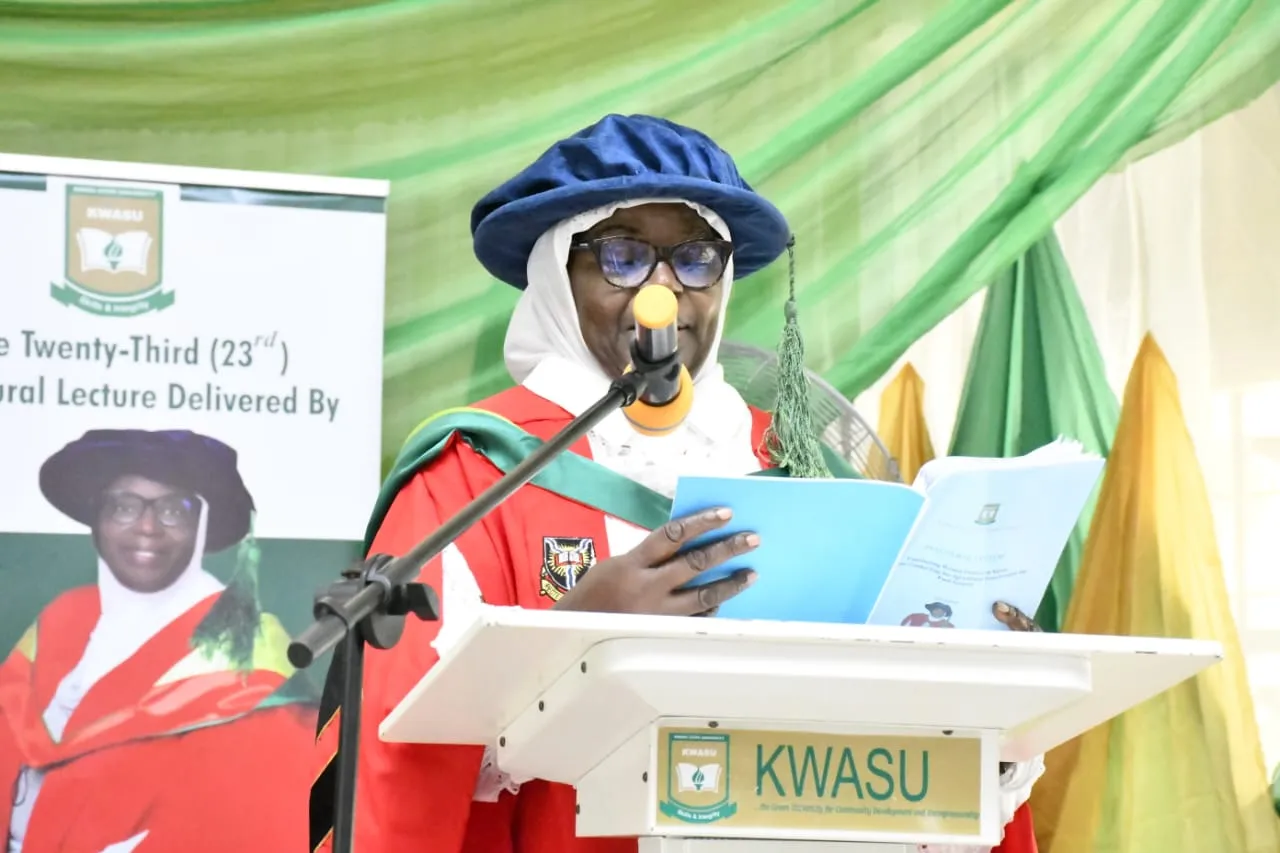
A Professor of Agricultural Economics at Kwara State University (KWASU), Malete, Taibat Moji Yusuf, has identified limited access to land, credit and other productive resources as major obstacles preventing women farmers from reaching their full potential and contributing more significantly to Nigeria’s food security.
The academic made the observation while delivering the university’s 23rd Inaugural Lecture titled, “Empowering Women Farmers in Nigeria: Closing the Gender Gap for Agricultural Transformation and Food Security.”
Drawing from over 30 years of field-based research and engagement with farming communities, Yusuf argued that empowering women in agriculture would not only boost food production but also help tackle poverty and drive sustainable economic growth.
She noted that despite playing critical roles in food production and rural livelihoods, many women farmers continue to face systemic barriers that limit their access to farmland, financing, agricultural inputs and modern farming technologies.
According to her, addressing these challenges requires comprehensive reforms in land ownership, agricultural financing, extension services and rural infrastructure.
The professor called on governments at all levels to review inheritance laws and land ownership policies to guarantee women equal rights to own and inherit land regardless of their marital status.
She also advocated joint land ownership arrangements for married couples, describing discriminatory land ownership practices as one of the biggest factors restricting women’s access to agricultural loans and productive resources.
To bridge the financing gap, Yusuf urged financial institutions to expand access to microcredit schemes that do not require land titles as collateral.
She further called for the development of agricultural loan products tailored to the realities and needs of women farmers, alongside wider deployment of digital financial services to reach women in remote rural communities.
The don also highlighted the need to strengthen agricultural extension services through the recruitment of more female extension workers and the introduction of flexible training schedules that accommodate women’s household responsibilities.
She recommended the use of mobile technology and local languages in delivering agricultural advisory services to farmers in rural areas.
Yusuf identified poor rural infrastructure as another major challenge facing women farmers, noting that inadequate access to water, electricity and childcare services often forces women to spend valuable time on unpaid domestic work.
According to her, increased investment in these areas would free up time for women to focus on farming activities and agribusiness ventures.
She also advocated wider access to mechanised processing equipment and labour-saving technologies specifically designed to meet the operational needs of women in agriculture.

The professor stressed that adult education programmes, agricultural training and cooperative societies would help improve women’s managerial capacity, facilitate the adoption of modern technologies and strengthen their bargaining power in agricultural markets.
She further called for policies that encourage income diversification through agro-processing, entrepreneurship and other off-farm economic activities.
Yusuf said improved roads, electricity supply and information and communication technology infrastructure would enhance the resilience of rural households and help them withstand economic and agricultural shocks.
The professor also urged both the government and private sector to expand contract farming arrangements and agricultural financing schemes through public-private partnerships.
According to her, such initiatives would provide women farmers with access to reliable markets, quality inputs and affordable financing opportunities.
She further advocated increased investment in post-harvest storage facilities, transportation networks, cold-chain systems and market information platforms to reduce food losses and improve profitability for women farmers.
On sustainable agriculture, Yusuf recommended the promotion of environmentally friendly farming technologies, particularly moringa-based bio-organic fertiliser, through agricultural extension programmes and cooperative production networks.
She encouraged communities to embrace moringa cultivation to ensure a steady supply of raw materials for producing the organic fertiliser.
The professor also called for gender-responsive agricultural policies, including mandatory gender impact assessments for government agricultural programmes and projects.
She urged policymakers to increase women's representation on agricultural boards, policy committees and farmers’ associations, while creating dedicated budget lines for investments targeted at women in agriculture.
Yusuf stressed the importance of establishing strong monitoring and evaluation mechanisms to assess the effectiveness of gender-focused interventions and ensure that intended beneficiaries are reached.
She argued that agricultural development strategies must be integrated with broader poverty reduction initiatives, noting that food security cannot be achieved independently of improvements in education, healthcare and employment opportunities.
With an estimated 140 million Nigerians reportedly living below the poverty line, she said coordinated action across sectors has become imperative.
The professor maintained that closing the gender gap in agriculture is not merely a matter of social justice but a strategic necessity for transforming Nigeria’s agricultural sector, boosting food production and achieving long-term national food security.
.webp)


Comments (0)
No comments yet. Be the first to share your thoughts!