


By Professor Abdullah Uba Adamu
Katsinawa never cease to amaze me. They put their money where their mouth is. Their desire for cultural preservation is truly legendary. Housing some of the most significant cultural interlocutors in northern Nigeria, they spare no efforts in cataloguing and documenting the cultural histories of Katsina, and by extension, northern Nigeria. And make no mistake about it, despite the much-vaunted commercialism of Kano, Katsina was first in almost everything; although not the best, for to be the best, you need to come to Kano.
Such was the case of Dauda Kahutu Rarara. Love him. Hate him. You can’t ignore him. Love it. Loathe it. You can’t ignore the performance genre he has crafted, not created, for there were many before him—and from which he has made stupendous amount of money—in the last two decades. Despite his ingenuity, it is trite to claim he is the best; certainly good in what he does—such judgement is a matter of personal choice, much like between apples and oranges, or guava and mango: all lovely healthy fruits, the best being a matter of personal preference and choice.
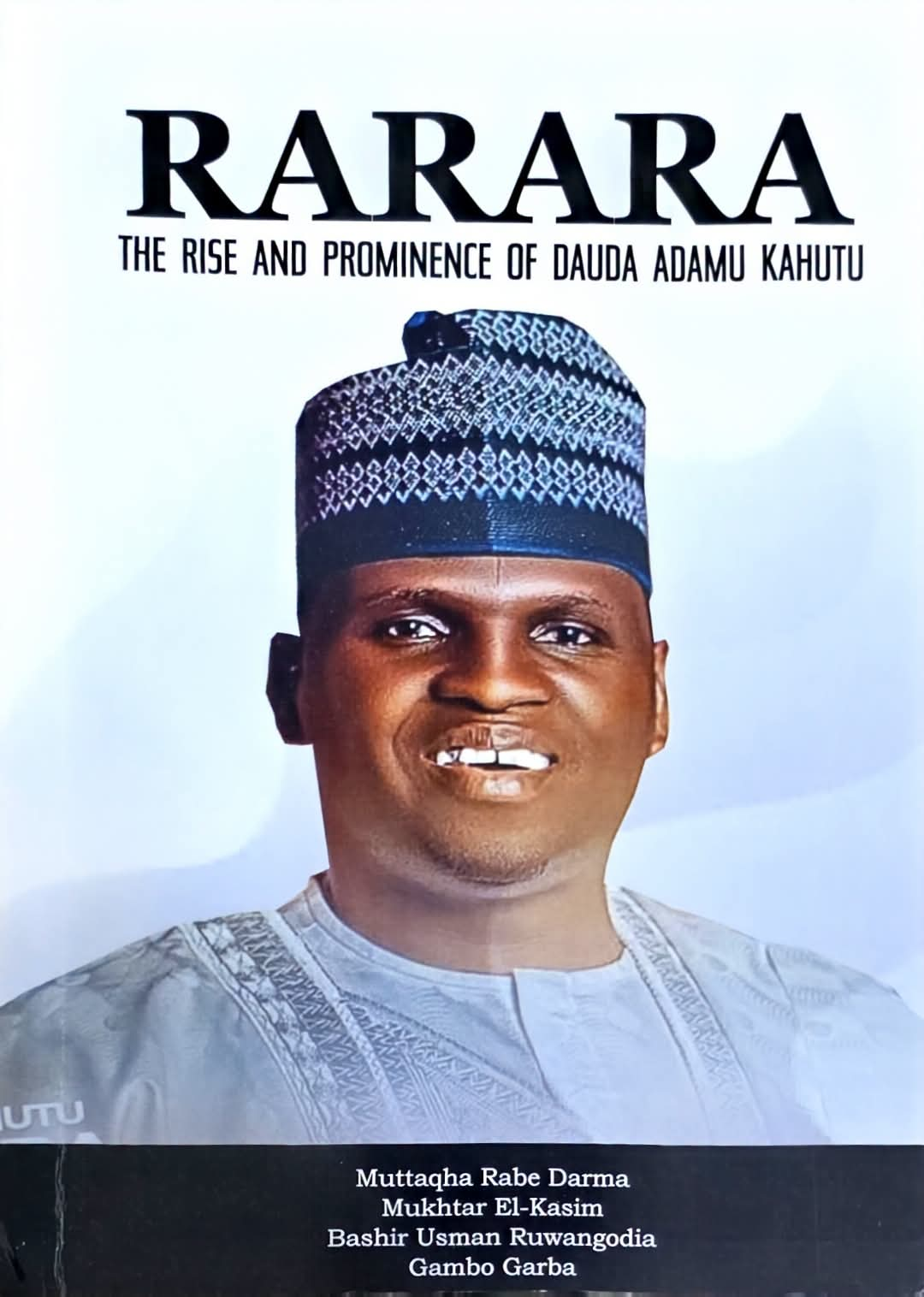
That was the backstory. Nowga labaran dalla-dalla. I was pleasantly surprised when on Saturday, November 14, I received a gift of two lovely books from Danjuma Katsina. Printed. Not Acibilisian eCopies. Katsinawa are the real deal. Old school and as real as can be. One was “Rarara: The Rise and Prominence of Dauda Adamu Kahutu” by Muttaqa Rabe Darma, Mukhtar El-Kasim, Bashir Usman Ruwangodia and Gambo Garba. The other was “Mamman Shata Katsina: The Singer as an Oral Philosopher in Hausaland”. This post is about the Rarara book. Next would be about the Mamman Shata book.
I have posted extensively on Rarara, and wrote a monograph on the Critical Discourse Analysis (CDA) of his performances. This was in a monograph titled “Rarara’s Invective Barbs: Innuendoes, Body Shaming, and Kano Politics.” I also recalled last summer there was ruckus about a proposed “1st International Conference on the Songs of Alhaji Dauda Kahutu Rarara” scheduled to be held in October 2025 at the Federal University Dutsin-Ma, Katsina State. Miscommunication all round scuttled that initiative, with apologies being issued here and there. Well, it seemed either the conference went on as planned, or if not, its spirit—documentation of the theme of the conference went right ahead, and the product is this book. So, all was well that ended well.
And even better, we now have a book. A big book. Some 516 pages, including an index. One thing that’s for sure: it is heavily researched. The authors interviewed some forty-three individuals from Kano to Zinder in Niger Republic. And Atlanta And London. No, they did not travel to these places, but used a perfectly valid phone interviews (which I hope were recorded for archival purposes) as sources for their information.
They also analysed about 196 of Rarara’s songs, categorizing them by subject matter. No surprises that 143 (about 73%) of them were classified as “political”. After all, Rarara classifies himself as a political singer. This, no doubt is the largest collection of contemporary political songs in modern Hausa performances. Love them or hate them. They are an awful lot. Irritatingly, the authors kept referring to Rarara as a musician. He is not. He is a lyricist, a songwriter and a singer. But does not play any instruments to the best of my knowledge. All the music in his song is composed by studio session musicians using piano synthesizers.
Now to gripes. The References only says “some academic and quasi-academic literature used.” There is nothing like “quasi-academic”; every opinion counts in research, it is just a matter of proper categorization. That is why “Letters to the Editor” are considered legitimate resources. And even then, for a book this expansive, you would have through that the libraries in BUK, UDUS and KASU would have been scoured for dissertations as references. But then, even at this, only five references were listed in the book. Curiously, EACH was repeated twice! Then the index, which is good, but too many “mark every entry” incidences. For instance, “Hausa” and “Rarara” have more than one hundred entries. “Buhari” has dozens. Same with “Kahutu”, “Kano”, “Katsina”. That’s all an overkill. An index should reference the most import part of the text, not every single occurrence.
Then the cover. It displays a large beautiful color picture of Dauda Kahutu under the banner title of the book. The first question I would ask myself was “who’s this guy?” And “Rise and Prominence” in WHAT, specifically? There is nothing that indicates in what he is prominent at. Whether he is a rocket scientist, an engineer, a politician, a banker or an AI expert. Certainly nothing in the picture suggests that he is a performing artist—no stage picture, no microphone in his hand, no concert shot. Nothing. The cover of a biography—and this IS a biography of his songs—should at least convey a sense of meaning of the person whose life we are about to unravel. Nice shot, though.

The book also contains many badly reproduced color pictures of various individuals, scenes and locations that were important to Rarara. Not a single shot I could see about his performance on stage, which is what made him prominent to begin with—just his philanthropy, which is not what the book is about (that would require a separate volume). The arrangement of the pictures is not particularly impressive. Some have their tops cut off, so you have no idea who was depicted, although a legend is printed across. Others show individuals with wide gaping mouths, which is certainly inelegant. Curiously, there were no picture of his very early childhood—just Rarara, looking well-fed and posing with famous people.
Despite some of these flaws, and not having read the entire book, I think this is an excellent effort at documenting one of the most visible vocalists in modern Hausa performing arts. From the looks of it, Dr. Darma and his team have done a very good job of cultural curating and documentation. I would hope that this book should be made available to Hausa cultural depositories like Wisconsin (US), SOAS (London, UK), Cologne (Germany) and Warsaw (Poland). .
I got mine free! If you want to own a copy, I was told you could refer to the editors of Katsina Times/Katsina City News for inquiries.
I leave you with the book’s blurb:.
“This book tells the remarkable story of Dauda Adamu Kahutu, Rarara, a boy from the village of Kahutu, who rose to become one of the most influential voices in Northern Nigeria. It begins with his birth in 1986, the rituals that welcomed him into family and faith, and the lessons of Qur'anic schooling, farm work, and village 'waƙa' that shaped his early years. From there it follows his journey to Kano, where hardship as an 'almajiri' turned into discovery and opportunity.
In Kano, he found his calling in music, first in Kannywood and later in political anthems that carried his name far beyond the city. His songs blended Hausa oral traditions with satire, praise, and bold commentary that captured the struggles and hopes of ordinary people. Some praised him as a cultural icon; others criticised him as controversial. Yet no one could deny the reach of his voice, from love songs that consoled the heart to campaign songs that swayed elections.
The chapters move beyond performance to explore the man himself; his family roots, his faith, his philanthropy, and his place in the wider story of Hausa society and Nigerian politics. They show how his work framed leaders and parties in words ordinary people could carry and repeat, why his songs stirred both laughter and debate, and how his voice became a mirror of his times. With more than 200 songs, countless interviews, and community projects that changed lives, Rarara's story is not only about music but about resilience, influence, and legacy.
This book captures that story in full: the boy of Kahutu, the singer of politics, the giver to his people, and the man whose words still echo across homes, markets, and campaign grounds.”



Comments (0)
No comments yet. Be the first to share your thoughts!