


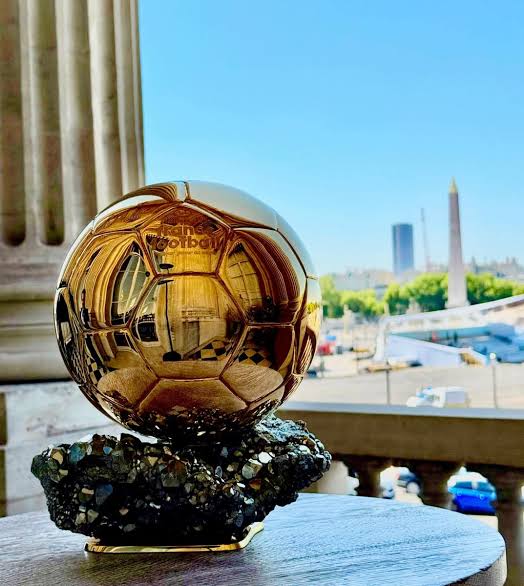
By Taibat Ummi Yakubu
Harry Kane has ended England’s 25-year wait for the men’s Ballon d’Or after being crowned the world’s best male footballer at a ceremony in London on Monday, following a remarkable season in which he scored 73 goals for club and country.
The Bayern Munich striker defeated competition from Real Madrid’s Kylian Mbappé and Barcelona’s Lamine Yamal to claim the prestigious award, becoming the first Englishman since Michael Owen in 2001 to win the honour.
Kane’s victory places him among a distinguished group of English footballers who have received the award, including Sir Stanley Matthews, Sir Bobby Charlton and Kevin Keegan.
The England captain’s achievement represents more than a personal milestone. It highlights the significance of individual excellence, sustained performance and contribution to team success in a sport where players are constantly competing for recognition at the highest level.
What the Ballon d’Or means to footballers
Created by French magazine France Football in 1956, the Ballon d’Or is one of football’s most prestigious individual awards. Its name translates from French as “Golden Ball”, and it recognises outstanding footballers based on their performances and achievements during a specified season.
Unlike league titles, domestic cups and continental trophies, which are won by teams, the Ballon d’Or recognises an individual player’s contribution to the game.
The award is particularly significant because footballers are assessed against other elite players competing across different clubs, leagues and national teams. Winning it places a player among the most celebrated figures in the sport and can become a defining moment in their career.
The selection process is based on established criteria, including individual performances and decisive contributions, team achievements, fair play and the player’s overall sporting conduct. International football journalists selected through the award’s voting system cast their votes to determine the winner.
Although goals are an important measure of a striker’s performance, they are not the only consideration. Creativity, consistency, influence in important matches, contribution to collective success and the overall quality of a player’s season can also shape the outcome.
This explains why winning the award is not simply a matter of scoring more goals than every other player. A footballer must build a compelling case through performances and achievements over the assessment period.
How Kane made history
Kane’s 73-goal return across the 2025/2026 campaign helped establish him as one of the outstanding performers of the season.
The striker’s achievements for Bayern Munich and England strengthened his position among the leading contenders, ultimately putting him ahead of Mbappé and Yamal in the final voting.
His triumph also brought an end to a lengthy wait for English football. Owen was the last Englishman to win the men’s award, receiving it in 2001 after an outstanding season with Liverpool.
Kane’s success follows years of development, setbacks and loan spells before he established himself as one of the leading forwards in European football.
Speaking after receiving the trophy, Kane expressed gratitude to France Football, the organisers and those who voted for him.
“Wow, I’m almost speechless. First of all, thanks again to France Football and the Ballon d’Or for this amazing event,” he said.
He added that receiving the award in London made the occasion particularly special.
Kane also acknowledged the contributions of Bayern Munich, England and his former club, Tottenham Hotspur, to his development and achievements.
Reflecting on his journey, he urged young people aspiring to become professional footballers not to abandon their ambitions because of early disappointments.
“For any young boy or girl who wants to achieve their dream, anything is possible,” he said.
He explained that his career had not followed a direct route to success, noting that loan moves and other challenges had formed part of his development.
“I hope my journey can inspire others. I didn’t go straight to the top; I had to experience several loan moves and fight my way to where I am now,” Kane added.
Why the award matters for players
For professional footballers, winning the Ballon d’Or can have implications that extend beyond the ceremony and the trophy itself.
Career recognition: The award gives a player international recognition and places their achievements in the wider history of football. It can strengthen their legacy and provide a major milestone in their professional career.
Commercial opportunities: A Ballon d’Or victory can increase a player’s visibility and marketability, potentially attracting sponsorships, advertising partnerships and other commercial opportunities. However, the financial benefits depend on individual contracts, market conditions and commercial agreements.
Reputation and influence: Winners often become reference points for aspiring footballers, coaches and analysts. Their performances and career decisions may receive greater attention, while their opinions can carry increased influence within the sport.

Motivation and confidence: Winning football’s highest-profile individual honours can reinforce a player’s belief in their abilities. However, maintaining performance at the highest level still requires discipline, training, fitness and continued improvement.
Historical legacy: The award provides a lasting record of individual achievement. For Kane, joining the select group of English winners adds another significant chapter to a career shaped by his goalscoring consistency and persistence.
The award can also increase scrutiny. Winners are often expected to maintain exceptional standards, while supporters and commentators may judge their subsequent performances against the season that brought them the trophy.
What young footballers can learn from Kane
Kane’s journey illustrates why talent alone does not always determine how far a footballer will progress.
His early loan spells demonstrate how players can develop through experience, competition and opportunities outside their original clubs. Such moves can provide valuable playing time, expose young footballers to different tactical systems and help them adapt to the physical and mental demands of senior football.
His achievement also highlights the importance of consistency. Producing a strong performance in one match can attract attention, but sustaining a high level across an entire season requires preparation, discipline, recovery and the ability to respond to setbacks.
Teamwork remains equally important. Although the Ballon d’Or recognises an individual, a striker’s output often depends on the quality of service from teammates, tactical organisation, coaching and the collective performance of the team.
Kane’s acknowledgement of his clubs, coaches and teammates underlines this relationship between individual recognition and collective effort.
For young players, the lesson is not that every footballer will win the Ballon d’Or, but that continuous development, patience and consistent performance can help create opportunities to reach higher levels of the game.
How the other contenders finished
Real Madrid forward Kylian Mbappé finished second, while Barcelona teenager Lamine Yamal placed third.
Manchester City’s Rodri came fourth, with Lionel Messi of Inter Miami finishing fifth. Paris Saint-Germain’s Khvicha Kvaratskhelia was sixth, followed by teammate Ousmane Dembélé in seventh.
Manchester City striker Erling Haaland finished eighth, while Bayern Munich’s Michael Olise and PSG midfielder Fabián Ruiz completed the top 10.
Yamal also received the Men’s Young Talent of the Year award, recognising his standing among football’s emerging stars.
In the women’s category, Spain international Alexia Putellas won the Ballon d’Or, adding another major individual honour to her career following her achievements with Barcelona and Spain.
Spain’s Luis de la Fuente was named Men’s Coach of the Year, while Barcelona’s Pere Romeu received the women’s coaching award.
Vicky López won the Women’s Young Talent of the Year award, while Mexico’s Charlyn Corral received the Women’s Striker of the Year prize.
Spain goalkeeper Unai Simón won the Men’s Goalkeeper of the Year award, with Barcelona’s Cata Coll taking the women’s honour. Paris Saint-Germain was named Men’s Club of the Year, while Barcelona won the Women’s Club of the Year award.
Arsenal and England forward Bukayo Saka received the Socrates Award in recognition of his humanitarian work.
Ceremony overshadowed by confusion
Despite the significance of the occasion, the ceremony was preceded by confusion after the Ballon d’Or website published separate articles naming Kane, Yamal and Mbappé as winners of the men’s award.
The event also began about 45 minutes behind schedule, with organisers attributing the delay to traffic congestion in London.
The confusion briefly added uncertainty to an evening intended to celebrate the achievements of football’s leading players.
Nevertheless, Kane ultimately emerged as the winner, bringing England’s long wait for another men’s Ballon d’Or champion to an end.
His victory serves as a reminder of the award’s enduring importance in world football: it recognises exceptional individual achievement while preserving a record of the players whose performances have helped define their era.
For Kane, the Golden Ball represents the reward for a remarkable season. For aspiring footballers, his journey offers a broader message about the value of perseverance, continuous improvement and making the most of opportunities along the way.
.jpg)
Comments (0)
No comments yet. Be the first to share your thoughts!