


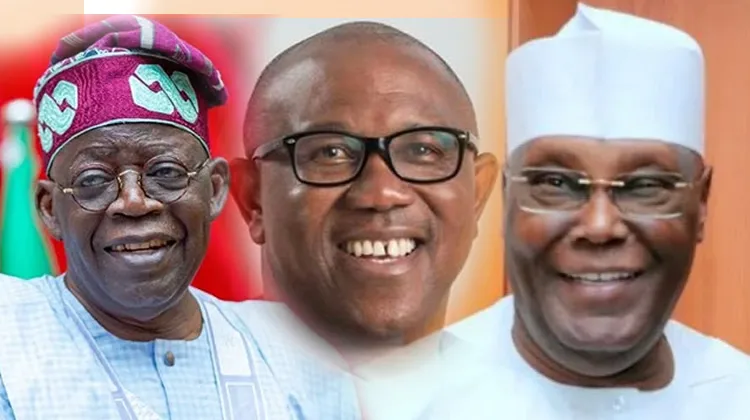
Nigeria’s race to the Presidency entered a decisive new chapter on Wednesday as official campaigning for the 2027 general election commenced, revealing sharply different strategies from the three leading contenders seeking to shape the nation’s future.
President Bola Ahmed Tinubu, former Vice President Atiku Abubakar and former Anambra State Governor Peter Obi each used the opening day of the campaign season to send distinct messages to Nigerians, offering an early glimpse into what is expected to be one of the country's most fiercely contested presidential elections.
The campaign period officially opened on August 19 ahead of the January 16, 2027 presidential election, just a day after presidential candidates signed the National Peace Accord in Abuja, committing themselves to peaceful and issue-based campaigns.
Tinubu Chooses Governance Over Rally Politics
Unlike the traditional fanfare often associated with the launch of presidential campaigns, Tinubu spent the first day of the race at the Presidential Villa in Abuja, presiding over a meeting of the Federal Executive Council (FEC).
It was his first FEC meeting since June 29, and the timing was significant.
Rather than stepping onto a campaign stage, the President projected the image of a leader focused on governance while simultaneously seeking re-election.
The council meeting produced several policy decisions touching on education, infrastructure and the economy. Among the key announcements was Tinubu’s directive that liquid assets recovered by the Economic and Financial Crimes Commission (EFCC) be channelled into the Nigerian Education Loan Fund, alongside resources from dormant accounts and unclaimed dividends to strengthen student financing.
For the President’s supporters, the move provided another opportunity to showcase what they describe as the administration’s reform agenda and commitment to long-term development.
Yet the reforms remain politically sensitive.
The removal of fuel subsidy and the unification of the foreign exchange market continue to divide public opinion. While the government insists the measures were necessary to rescue the economy, many Nigerians continue to grapple with rising living costs and economic hardship.
As a result, Tinubu’s campaign is expected to revolve around a central question: should voters judge his administration by the immediate pain caused by the reforms or by the long-term benefits his government says will eventually emerge?
Atiku Fires First Major Economic Salvo
While Tinubu focused on governing, Atiku wasted little time in taking aim at one of the administration’s most controversial policies.
The African Democratic Congress (ADC) presidential candidate addressed Nigerians through a Facebook Live session, using the platform to promise a return of petrol subsidy if elected in 2027.
The pledge immediately positioned him on a collision course with the Tinubu administration’s economic agenda.
Atiku questioned the benefits Nigerians have received since the subsidy was removed and argued that citizens should have seen clearer improvements in public services if the policy was delivering as promised.
His message sought to tap into widespread frustrations over inflation and the rising cost of living, making economic hardship the centrepiece of his opening campaign pitch.
The former vice president also intensified scrutiny of government finances.

Through a statement issued by his Senior Special Assistant on Public Communication, Phrank Shaibu, Atiku called for greater transparency regarding trillions of naira in federation revenues, deductions, savings and transfers, insisting that Nigerians deserve a full account of how public funds are being managed.
By combining criticism of subsidy removal with calls for financial accountability, Atiku signalled that challenging the government's economic record will remain a cornerstone of his campaign.
Obi Calls for a Different Kind of Election Debate
Peter Obi adopted a markedly different approach.
Rather than focusing on a dramatic policy reversal or direct attacks on opponents, the former Anambra governor used the opening day to challenge Nigerians to scrutinise those seeking public office.
Through his media office, Obi was presented as a “Candidate of Conscience,” urging voters to evaluate candidates based on competence, integrity, performance records and policy substance rather than campaign slogans.
The National Democratic Coalition (NDC) candidate argued that the next 150 days should be devoted to serious conversations about governance and leadership capacity.
His campaign outlined priorities including boosting production, reducing the cost of governance, improving security, strengthening healthcare and education, and expanding economic opportunities.
The message reinforced the political identity Obi has cultivated over recent years—one centred on prudence, accountability and productivity.
His camp maintained that the election should be decided not by political theatrics or party structures, but by a careful examination of each candidate’s track record and ability to solve Nigeria’s pressing challenges.
A Three-Way Battle Takes Shape
The first day of campaigning highlighted the contrasting paths each contender intends to take in the months ahead.
Tinubu is expected to rely heavily on the record of an incumbent administration that has pursued far-reaching economic reforms, even as critics question their impact on ordinary Nigerians.
Atiku appears determined to channel public dissatisfaction into a case for political change, with fuel subsidy restoration emerging as one of his earliest and most striking promises.
Obi, meanwhile, is seeking to elevate competence, accountability and economic productivity as the defining issues of the election, urging voters to look beyond party loyalty and campaign rhetoric.
While the official campaign season has only just begun, the opening day revealed the battle lines that are likely to dominate political discourse in the months ahead.
For voters, the contest is no longer merely about personalities, it is increasingly becoming a debate over economic direction, governance, accountability and the future of Africa’s most populous nation.
As the race gathers momentum, the challenge for each candidate will be transforming these opening messages into the broad public support needed to secure victory at the polls.
Comments (0)
No comments yet. Be the first to share your thoughts!