


By Taibat Ummi Yakubu
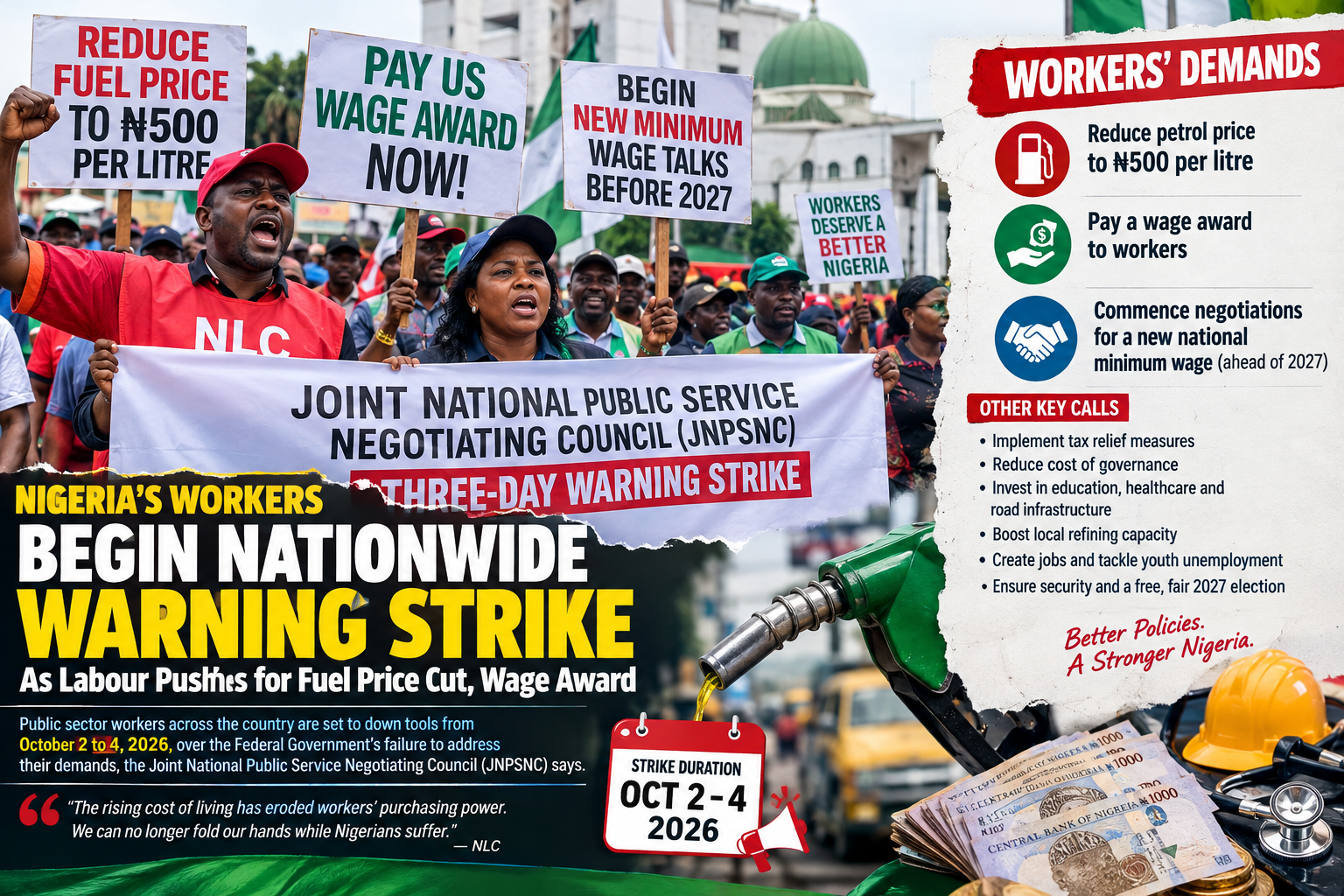
Thousands of public sector workers across Nigeria are set to embark on a three-day warning strike beginning today, following a directive issued by the Joint National Public Service Negotiating Council (JNPSNC) over what it described as the Federal Government’s failure to address growing economic hardships confronting workers.
The industrial action, which is expected to run from October 2 to October 4, affects employees in the federal, state and local government services. Labour leaders say the strike is aimed at drawing urgent attention to worsening living conditions and mounting financial pressures facing public servants across the country.
At the heart of the dispute are demands for a reduction in the pump price of petrol to N500 per litre, the payment of a wage award to workers and the commencement of negotiations for a new national minimum wage ahead of 2027.
In a circular dated October 1, 2026, and signed by the National Secretary of the council, Olowoyo Gbenga, the JNPSNC said the decision followed the government’s alleged failure to respond to concerns and demands earlier submitted to President Bola Ahmed Tinubu in a letter dated September 21.
The council maintained that the warning strike had become necessary as workers continue to grapple with soaring transportation costs, rising food prices and increasing expenses in virtually every aspect of daily life.
“The strike shall commence from Friday, October 2, and end on Sunday, October 4, 2026,” the circular stated, directing public servants across all three tiers of government to fully participate in the action.
NLC Throws Weight Behind Workers
Meanwhile, the Nigeria Labour Congress (NLC) has openly backed the demands of the negotiating council, intensifying pressure on the government to implement measures aimed at easing the burden on workers and ordinary Nigerians.
In its Independence Day message signed by its President, Joe Ajaero, the NLC argued that rising living costs have significantly eroded workers’ purchasing power, leaving many families struggling to meet basic needs.
The labour centre pointed to the sharp increase in petrol prices since the removal of fuel subsidy in 2023, noting that transportation costs have triggered a chain reaction across the economy.
According to the NLC, petrol now sells for as much as N1,430 per litre in major cities and even higher in some remote communities, pushing up the cost of food, housing, education and other essential services.
The congress insisted that any meaningful attempt to tackle the current economic crisis must begin with addressing the impact of fuel prices on transportation and the wider economy.

It also renewed calls for an immediate nationwide wage award covering workers in federal, state and local government institutions, describing the measure as an urgent intervention to cushion the effect of declining real incomes.
Labour Demands New Minimum Wage Talks
Beyond immediate relief measures, the NLC urged the Federal Government to begin discussions on a fresh national minimum wage, warning that existing wage structures are increasingly unable to cope with current economic realities.
The labour movement further accused the government of failing to fully implement tax relief measures contained in the October 2023 Memorandum of Understanding reached with organised labour.
It also called for greater transparency in public spending, a reduction in the cost of governance and increased investment in critical sectors such as healthcare, education and road infrastructure.
The congress questioned the benefits of fuel subsidy removal, arguing that many Nigerians have yet to see tangible improvements in public services despite the policy’s implementation.
The union additionally advocated stronger support for local refining capacity, saying Nigeria’s continued dependence on imported petroleum products remains a major economic challenge.
Concerns Over Youths, Security and 2027 Elections
The NLC also highlighted growing concerns over youth unemployment and the increasing number of young Nigerians leaving the country in search of better opportunities abroad.
According to the labour body, creating jobs and expanding economic opportunities are essential steps toward restoring confidence among the nation’s youth.
On insecurity, the congress warned that violence and instability continue to affect farming, healthcare delivery and education, while worsening poverty and inequality.
Looking ahead to the 2027 general elections, the NLC called for a free and fair electoral environment, urging authorities to prevent voter intimidation, electoral manipulation and divisive rhetoric capable of inflaming ethnic or religious tensions.
The union stressed that Nigerian workers must be allowed to make independent political choices and reaffirmed its commitment to advocating policies that protect the welfare and interests of workers across the country.
With the warning strike now underway, attention is expected to focus on whether fresh dialogue between labour leaders and government officials can avert a broader industrial action in the coming weeks.

Comments (0)
No comments yet. Be the first to share your thoughts!