By Zaharaddeen Ishaq Abubakar | Katsina Times
Katsina State Governor, Malam Dikko Umar Radda, has described Zakat and Waqf as critical instruments for tackling poverty, inequality and social injustice, reaffirming his administration’s commitment to strengthening structured Zakat administration in the state.
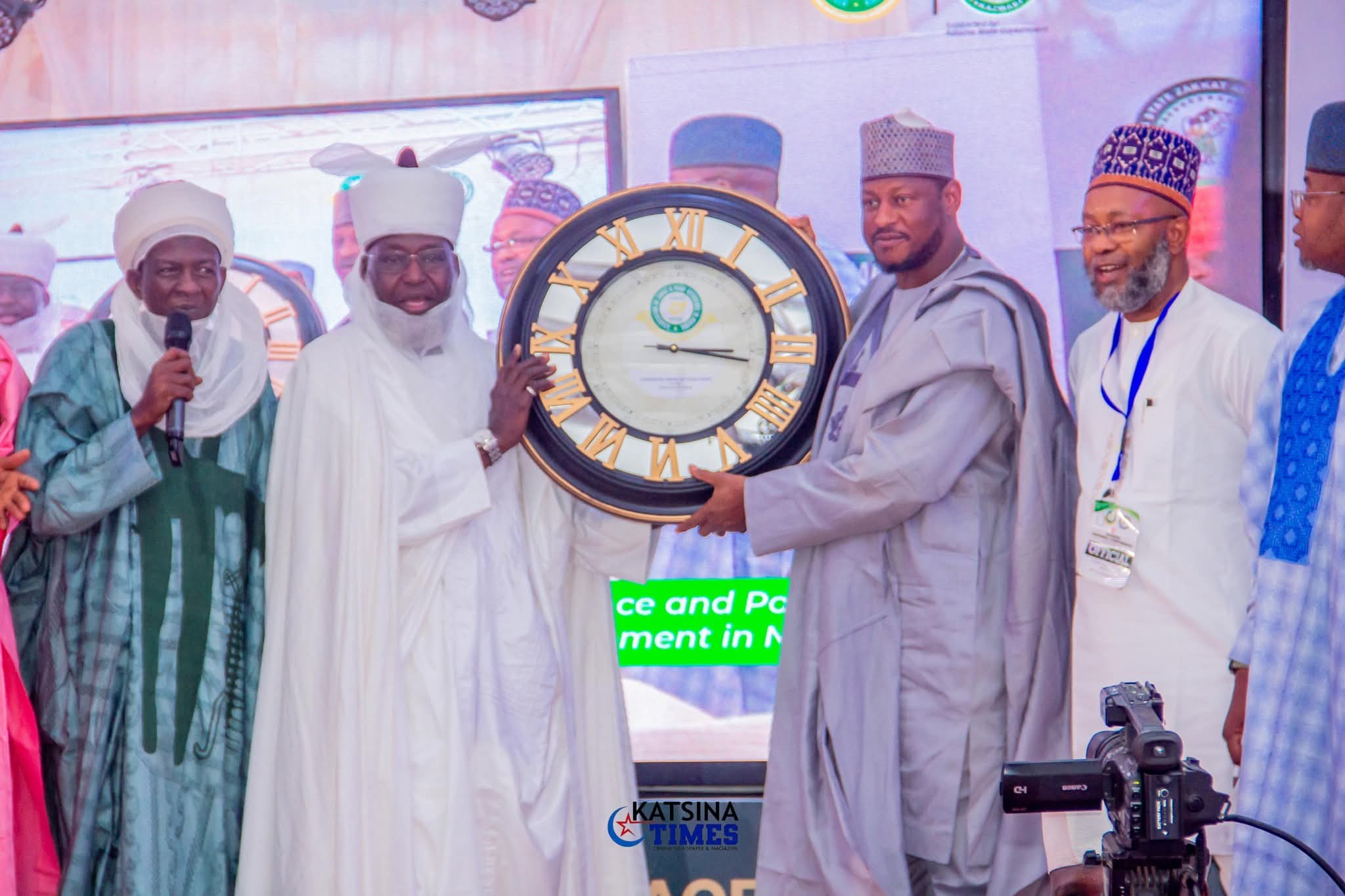
Governor Radda made this known on Monday, December 22, 2025, while delivering his address at the 5th National Conference of the Association of Zakat and Waqf Operators in Nigeria (AZAWON), held at the Hillside Conference Hall, Katsina.
According to the governor, hosting the national conference marked a significant milestone in the history of Katsina State, stressing that the decision to bring the event to the state was deliberate and strategic.
“Today is a very important day in the history of our dear state. Hosting this conference is a decision that will live with us for a long time, and we do not take it for granted,” Radda said.
He explained that the establishment of the Katsina State Zakat and Waqf Commission was a conscious policy choice aimed at addressing poverty, injustice and the welfare of the most vulnerable in society.
“The creation of the Zakat and Waqf Commission in Katsina State is not accidental. It was carefully planned to address poverty and to support those in dire need,” the governor stated.
Radda noted that within nearly two years of operation, the commission had recorded notable achievements under the leadership of its chairman and board, whom he commended for their dedication and transparency.
Highlighting his administration’s broader social intervention policies, the governor said Katsina State had invested heavily in poverty reduction, women empowerment, agriculture and small business development.
He disclosed that over ₦10 billion had been set aside to support micro, small and medium-scale enterprises (MSMEs), placing Katsina among the leading states in MSME funding nationwide. He also revealed that the state’s women empowerment initiative, launched earlier in the year at a cost of about ₦5.7 billion, had benefited over 40,000 women across the state.
In addition, Radda said the government recently distributed food commodities to about 90,000 vulnerable households across Katsina, while also investing over ₦70 billion in agricultural production, inputs and innovations to support small, medium and large-scale farmers.
“These investments were responsible for the bumper harvest recorded in the state this year,” he added, noting that agriculture remains the backbone of Katsina’s economy, engaging about 90 to 95 percent of the population.
Earlier in his address, the National Chairman of AZAWON and Executive Chairman of the Sokoto State Zakat and Endowment Commission (SOZEA), Muhammad Lawal Maidoki, also known as Sadaukin Sakkwato, said the association’s conferences had laid a strong foundation for best practices in Zakat and Waqf administration across Nigeria.
He noted that despite Nigeria’s vast human and natural resources, the country continues to face severe socio-economic challenges, including poverty and unemployment.
“Over 133 million Nigerians are multidimensionally poor, while youth unemployment exceeds 30 percent. These are not just statistics; they represent real people and families struggling for dignity,” Maidoki said.
He stressed that Islamic social finance — particularly Zakat, Waqf and Sadaqah — offers a comprehensive and humane response to poverty and inequality.
According to him, since the formal organization of Zakat and Waqf administration through AZAWON, member institutions across Nigeria have collectively recorded over ₦10 billion in Zakat collections, ₦3.7 billion in Waqf, and about ₦465 million in Sadaqah, all distributed to the needy.
“This achievement is unprecedented in Nigeria and indeed across the West African sub-region,” he said.
Also speaking, the Executive Chairman of the Katsina State Zakat and Waqf Commission, Dr. Ahamed Filin Samji, commended Governor Radda for establishing a structured and transparent Zakat system in the state. He said the commission had significantly improved coordination and accountability in Zakat collection and distribution, while ensuring that funds reach eligible beneficiaries in line with Islamic principles.
The Emir of Kazaure, Alhaji Adamu Abubakar, who represented the Sultan of Sokoto, His Eminence Alhaji Sa’ad Abubakar, urged Muslims to fulfill their obligation of Zakat and embrace Waqf as a form of continuous charity (sadaqah jariyah).
The conference attracted representatives of the governors of Kano, Niger, Kaduna and Jigawa states, traditional rulers including district and village heads, representatives of the Emirs of Katsina and Daura, as well as Muslim faithful from within and outside Nigeria, including the Niger Republic.