


By Taibat ummi Yakubu
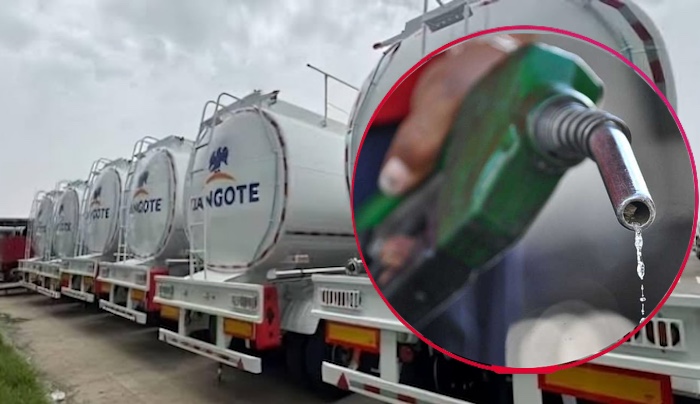
The battle over Nigeria’s petrol market has taken a new turn as the Dangote Petroleum Refinery stops supplying Premium Motor Spirit (PMS) to major marketers that continue to import petrol into the country.
The refinery said the move was aimed at protecting the quality and identity of its locally refined fuel, amid concerns that its products could be mixed with imported petrol and later marketed as Dangote fuel.
An official of the refinery confirmed the decision, explaining that the facility was unwilling to supply marketers who simultaneously import petroleum products.
“We are not selling petrol to those who are importing, since they are trying to blend our high-quality products with their ultra-low-quality imported products,” the official said.
The refinery has instead shifted its focus towards independent petroleum marketers and other buyers who do not bring competing petrol into the country. A source familiar with its distribution operations confirmed that the change was already being implemented.
“We are selling to independent marketers and others who are not importing,” the source said.
The development could force some major oil marketers to reconsider how they source petrol, particularly companies that have relied on a combination of domestic purchases and imports to meet their distribution needs.
It has also opened a fresh debate in Nigeria’s downstream petroleum sector, with stakeholders offering different interpretations of the refinery’s decision. While some view it as a commercial move to protect the refinery’s brand and product quality, others believe it raises questions about how competition should operate in a rapidly changing fuel market.
For the Petroleum Products Retail Outlets Owners Association of Nigeria (PETROAN), however, the decision is largely a matter for the refinery to determine.
PETROAN National President, Dr Billy Gillis-Harry, said Dangote, as the owner of the facility, had the right to decide how to run its business.
“We remain indifferent to his decision to cut fuel supply to fuel importers since Dangote is the owner of his asset. Let him do whatever he likes with his business,” he said.

Gillis-Harry, however, maintained that the government still had a role to play in determining whether the refinery's operations and distribution practices remain within the broader regulatory framework governing Nigeria's petroleum industry.
Energy expert Rasheed Adeleke offered a different perspective, arguing that the decision should not automatically be interpreted as an attempt to dominate the market.
According to him, the refinery may simply be trying to protect the identity and quality of its products, particularly as the mixing of locally refined petrol with imported fuel could make it difficult for consumers and regulators to establish where particular products originated.
Adeleke said stronger patronage of domestic refineries could also help Nigeria reduce its dependence on imported petroleum products while keeping more value within the local economy.
The latest development comes as Aliko Dangote continues to push for a broader expansion of Nigeria's refining capacity, arguing that the country cannot depend on a single major refinery to meet its long-term energy requirements.
Speaking at the Nigeria Oil Refining Summit 2026 in Lagos, Dangote said domestic refineries received about 683,000 barrels of crude per day in August, while Nigeria's crude oil and condensate production reached approximately 1.74 million barrels per day in June.
He said the country was gradually moving away from the longstanding contradiction of producing crude oil while relying heavily on imported petrol, but warned that establishing refineries was only the beginning.
“Today, Nigeria is moving away from the contradiction of being a major crude producer that depends on imported fuel. But building refineries is only the beginning,” Dangote said.
He called for the development of “many successful refineries” spanning large, medium, modular and specialised facilities, saying a stronger refining industry could generate employment, conserve foreign exchange and accelerate industrial development.
Dangote also stressed the importance of a competitive downstream market where imported and locally refined products operate under comparable regulatory, tax, quality and commercial conditions.
He identified reliable crude supply, predictable government policies, stable pricing and import rules, taxation and access to foreign exchange as key factors needed to attract further investment into the refining sector.
Beyond refining itself, he said Nigeria must improve its supporting infrastructure, including ports, pipelines, storage facilities and roads, to reduce the cost of transporting petroleum products across the country.
As the Dangote refinery tightens its distribution strategy, the immediate question now is how major fuel marketers affected by the decision will respond and whether the latest development will trigger a broader shift in the way petrol is sourced and distributed across Nigeria.

.jpg)

Comments (0)
No comments yet. Be the first to share your thoughts!