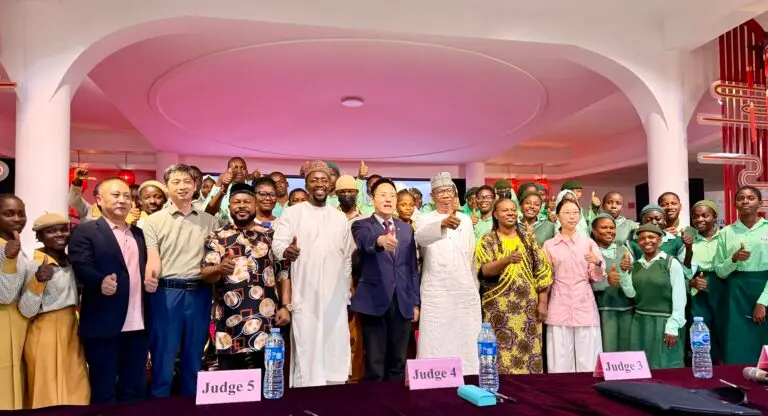
The Federal Capital Territory (FCT) Education Secretariat has announced plans to expand Chinese language education in public schools as part of efforts to deepen educational and cultural exchanges between Nigeria and China.
The Permanent Secretary of the Secretariat, Mrs Joy Okeke, disclosed this on Friday during the 19th and 25th Nigeria Division of the Chinese Bridge Chinese Proficiency Competition for Secondary School and University Students in Abuja.
Okeke described language as a critical instrument for communication, cultural preservation, trade and international cooperation, stressing the importance of equipping students with skills that would enhance global engagement.
She commended the Chinese Embassy for promoting Mandarin language education in Nigeria, noting that China’s rich cultural heritage and growing global influence made the initiative beneficial to Nigerian students.
“It is highly commendable that the Chinese Embassy, with its 5,000 years of civilisation and over 200 million learners of Mandarin worldwide, is promoting the language up to secondary school level, particularly in the FCT,” she said.
According to her, the FCT Administration is putting in place the necessary structures to commence full-scale Chinese language instruction in public schools.
Okeke noted that FCT schools remain the only public secondary schools in Nigeria with established Chinese Corners, where students participate in language learning, Wushu, cultural performances, lion dances, arts and crafts, and other exchange activities.
She further praised the Chinese Embassy for its sustained partnership with the FCT Education Secretariat and urged students to take advantage of opportunities provided through Chinese language education.
Earlier, the Cultural Counsellor of the Chinese Embassy in Nigeria and Director of the China Cultural Centre, Mr Yang Jianxing, described the Chinese Bridge competition as an important platform for strengthening educational and cultural ties between Nigeria and China.
Yang said learning Chinese provides access to the country’s civilisation, literature, history and cultural heritage.
“The Chinese language is a key to the treasure house of Chinese civilisation. It carries the poetic beauty of classical literature, the wisdom embedded in idioms and historical allusions, and the profound heritage of thousands of years of history,” he said.
He encouraged participants to pursue their ambitions through language learning and cultural understanding, noting that the competition’s theme, “Chasing Dreams Through Chinese, Making Every Moment Count,” reflected the transformative power of education and international exchange.
Yang also noted that 2026 marks the 55th anniversary of diplomatic relations between Nigeria and China, as well as the China-Africa Year of People-to-People Exchanges.
He assured that the Chinese Embassy and the China Cultural Centre would continue supporting Confucius Institutes and Chinese language classrooms across Nigeria while creating more opportunities for youth engagement between both countries.
“We will actively build platforms for youth exchanges between the two countries and continue holding diverse cultural events so that more Nigerian young people can carry the torch of China-Nigeria friendship into the next generation,” he said.
The News Agency of Nigeria (NAN) reports that in the secondary school category, Micheal Justina of the Confucius Institute at Nnamdi Azikiwe University emerged overall winner with 95.2 points, while Umezurike Chinaetugo placed second.
In the university category, Emmanuel Faith secured first position with 94 points, while Onyeocha Ugochi came second.
The winners will represent Nigeria at the global Chinese Bridge finals in China.
The overall winners will participate in the international competition, where contestants ranked among the top 30 globally will receive full scholarships to study in China, while second-place winners will embark on an all-expenses-paid cultural exchange tour sponsored by the Chinese government.