


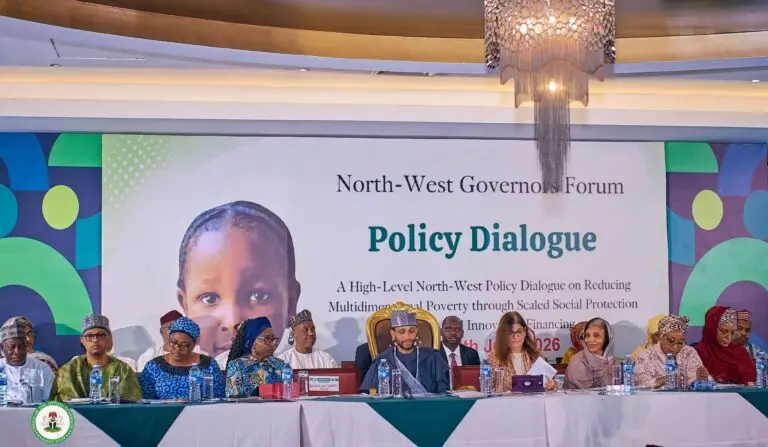
Governors of Nigeria’s North-West region have intensified efforts to combat multidimensional poverty, convening a high-level policy dialogue aimed at strengthening social protection systems and exploring innovative financing mechanisms to support vulnerable populations.
The meeting, organised by the North-West Governors’ Forum (NWGF) in Kano, brought together policymakers, development partners, and experts from the seven states of the region to discuss sustainable strategies for addressing poverty and improving social welfare.
Participants at the summit focused on developing practical solutions to challenges affecting children, women, and other vulnerable groups, while advocating stronger regional collaboration to improve living standards.
Speaking at the opening ceremony, Kano State Governor, Abba Yusuf, stressed that social protection should be viewed as a long-term investment in human development, economic growth, and social stability rather than merely a welfare programme.
Represented by Deputy Governor Murtala Sule-Garo, Yusuf highlighted measures already implemented by the state, including the enactment of the 2025 Social Protection Policy Law and the creation of a Social Protection Directorate under the Ministry of Humanitarian Affairs and Poverty Alleviation.
According to him, the state government has continued to channel resources into education, healthcare, youth empowerment, skills acquisition, and other intervention programmes designed to improve the wellbeing of residents.
He noted that reducing poverty across the region would require a departure from isolated interventions in favour of integrated, data-driven, and accountable social protection systems capable of reaching those most in need.
In her remarks, Director-General of the North-West Governors’ Forum, Maryam Yahaya, described the gathering as a critical step toward addressing the region’s socio-economic challenges.
She observed that despite the North-West’s vast population, economic prospects, and human resources, it continues to grapple with high poverty rates, poor health indicators, insecurity, and a growing population of out-of-school children.
Yahaya emphasised that the challenges facing the region transcend state boundaries and require coordinated responses, adding that investment in social protection remains essential for achieving stability, productivity, and sustainable development.
She also disclosed that the forum had adopted the North-West Peace, Security and Development Framework to address fragility and promote human development through a combination of peace-building, economic growth, and social welfare initiatives.
Also speaking, UNICEF Deputy Representative, Dr. Rownak Khan, raised concerns over the condition of children in the region, citing high maternal mortality rates, widespread malnutrition, stunted growth, and inadequate access to essential social services.
Khan stressed the importance of child-centred social protection programmes, particularly unconditional cash transfers, noting that such interventions could significantly improve access to healthcare, education, and nutrition.
Stakeholders at the event expressed optimism that stronger regional cooperation and sustainable financing strategies would accelerate poverty reduction efforts.
One participant, Muhammad Haruna, said expanding social protection programmes and adopting innovative funding models could substantially reduce poverty across the North-West.
Another participant, Halima Yusuf, called for inclusive policies and community-based approaches to ensure that assistance reaches the most vulnerable members of society.
She further urged sustained collaboration among government institutions, development partners, and civil society organisations to develop long-term solutions capable of addressing both immediate social needs and broader development challenges.