


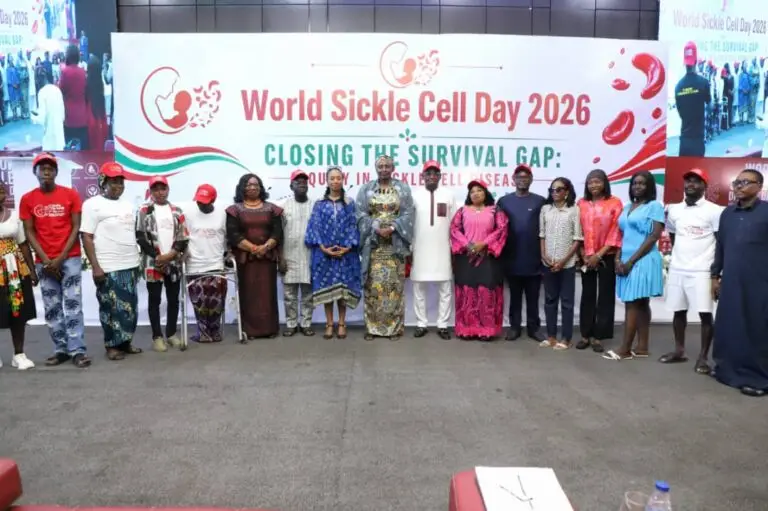
The Federal Government has begun implementing the Universal Newborn Screening Policy for Sickle Cell Disease (SCD) in selected health facilities across Lagos, Kano and the Federal Capital Territory (FCT), as part of efforts to reduce the burden of the disease and improve early diagnosis.
The Coordinating Minister of Health and Social Welfare, Prof. Muhammad Pate, announced the development on Friday in Abuja during a news conference to commemorate the 2026 World Sickle Cell Day.
Represented by the Permanent Secretary of the ministry, Ms Daju Kachollom, Pate said the initiative was being implemented with support from the Clinton Health Access Initiative (CHAI).
He also disclosed that the government had revised the National Guidelines for the Prevention, Control and Management of Sickle Cell Disease to strengthen the use of Hydroxyurea therapy and other proven interventions.
According to him, training of primary healthcare workers has commenced, starting from the South-West, while standard operating procedures and desk guides are being distributed nationwide to support implementation.
Pate said the government had established and equipped six Centres of Excellence for Sickle Cell Disease, one in each geopolitical zone, to improve access to specialised diagnosis and treatment.
The centres, he noted, are equipped with High-Performance Liquid Chromatography machines and other essential resources for newborn screening, diagnosis and comprehensive patient care.
Describing sickle cell disease as a major public health concern, the minister said about 25 per cent of Nigeria's adult population carries the sickle cell gene, while an estimated 100,000 infants die annually from complications linked to the condition.
He said the deaths account for about eight per cent of infant mortality in the country.
"Our focus is not only on creating awareness but on accelerating actions that will close the survival gap and ensure access to timely diagnosis, quality treatment and financial protection for all affected persons," he said.
Pate further revealed that the government was engaging the National Health Insurance Authority (NHIA) to include affordable newborn screening, essential diagnostic services and subsidised Hydroxyurea therapy in the national health insurance benefit package.
He stressed that access to life-saving treatment should not depend on an individual's financial capacity.
The minister added that the government would continue integrating sickle cell services into maternal, newborn, child and adolescent health programmes while strengthening research, surveillance and partnerships.

Earlier, the Director of Public Health, Dr Charles Nzelu, said Nigeria remained the country with the highest burden of sickle cell disease in Africa.
He noted that only about half of children born with the disease survive beyond the age of five in Nigeria, compared to more than 95 per cent survival rates recorded in developed countries.
Nzelu emphasised the importance of prevention and called on traditional and religious leaders, civil society groups, development partners and the media to intensify awareness campaigns.
Also speaking, the Director of the Centre of Excellence for Sickle Cell Disease Research and Training at the University of Abuja, Prof. Obiageli Nnodu, said the centre had screened over 38,000 babies through newborn screening programmes in the FCT.
She added that a national disease registry containing data of more than 10,000 patients from 25 centres across the country had been established.
Nnodu said the centre was also scaling up the use of Hydroxyurea therapy, noting that uptake of the treatment remained below 20 per cent nationwide.
According to her, healthcare workers are currently being trained across 16 sites to improve access to the treatment, while more than 700 genetic counsellors have been trained nationwide.
She also disclosed that radio awareness campaigns on newborn screening had commenced across the six geopolitical zones.
Sharing his experience, a person living with sickle cell disease, Mr Kenneth Maduka, appealed for increased government support and stronger measures to combat stigma against patients.
Maduka said many people living with the condition continue to face recurrent health challenges, high treatment costs and discrimination despite their qualifications and capabilities.
He urged the government to expand support programmes for patients, saying such interventions would significantly improve their quality of life.



Comments (0)
No comments yet. Be the first to share your thoughts!