


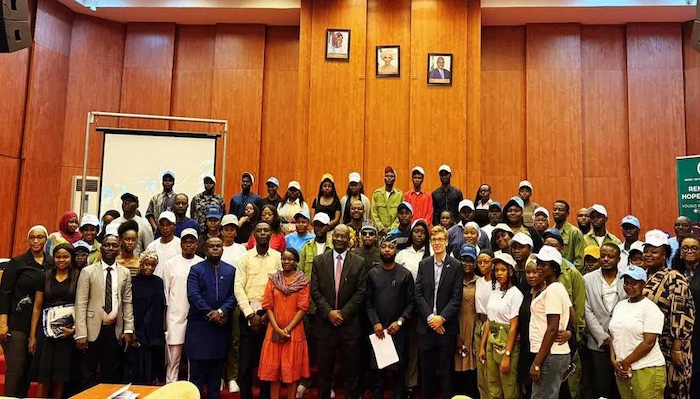
With political activities ahead of Nigeria’s 2027 general elections gradually gathering momentum, the Institute for Peace and Conflict Resolution (IPCR), the United Nations and the British High Commission have urged young Nigerians to take the lead in preventing political violence, hate speech, misinformation and other threats capable of undermining national stability.
The call was made during a youth peacebuilding training programme held in Abuja under the Renewed Hope Agenda for Young Peacebuilders, where participants were challenged to move beyond being mere observers of conflict and become active advocates for peace, dialogue and social cohesion.
The programme, organised by the IPCR, brought together National Youth Service Corps (NYSC) members, SIWES participants, interns and volunteers from different parts of the country. Speakers at the event stressed that with Nigeria approaching another election cycle, young people would play a crucial role in determining whether political competition strengthens democracy or fuels division and violence.
Delivering the keynote address, the Director-General of the IPCR, Dr. Joseph Ochogwu, described the training as an investment in the next generation of peacebuilders. He said the objective was not only to help participants identify the causes of conflict but also to equip them with practical skills to prevent disputes, manage tensions and transform disagreements into opportunities for development.
According to him, peacebuilding should not be viewed as the exclusive responsibility of government institutions or security agencies, but as a collective duty that requires the participation of every citizen.
“Peacebuilding is not the responsibility of government alone. It belongs to every citizen,” he said.
Ochogwu noted that Nigeria’s rich diversity in ethnicity, religion, language, culture and political opinion remains one of its greatest strengths. However, he warned that those same differences could become sources of instability if not properly managed through dialogue, tolerance and mutual understanding.
He challenged participants to rethink the traditional understanding of peace, arguing that peace is not merely the absence of violence but the presence of justice, respect, human dignity and constructive engagement among people with differing views.
“Peace is the ability of people with different opinions to disagree without becoming enemies,” he stated.
The IPCR chief also expressed concern over the growing influence of misinformation, disinformation and hate speech, particularly on social media platforms where false narratives can spread rapidly and inflame existing tensions.
He warned that political disagreements often degenerate into personal attacks, while rumours and inflammatory content can deepen ethnic, religious and community divisions.
According to him, a conflict-sensitive young person can prevent minor disagreements from escalating into crises, while individuals trained in mediation can help conflicting groups find common ground.
He therefore urged participants to approach their online activities with a strong sense of civic responsibility, stressing that every social media post, comment or message has the potential to either promote peace or contribute to instability.
“When you hear a rumour capable of provoking violence, do not become part of its distribution. Verify,” he advised.
Ochogwu encouraged young Nigerians to use their digital influence positively by promoting tolerance, countering falsehoods and building bridges across political, ethnic and religious divides.
“Use your digital influence to promote peace. Use your voice to encourage tolerance. Use your platforms to challenge falsehood. Use your networks to promote unity,” he said.
He added that social media should evolve from a platform often associated with hostility and division into a tool for education, dialogue and constructive civic engagement.
Also speaking at the event, the United Nations Peace and Development Adviser, Ms. Grace Kpohazounde, warned that the period leading to the 2027 elections could witness heightened political tensions and attempts to manipulate young people into activities capable of threatening peace.
She urged participants to become vigilant observers of their communities and actively confront early warning signs of conflict whenever they emerge.
“You, the youth, are sometimes manipulated into engaging in activities that are not necessarily contributing to peace,” she said.
Kpohazounde stressed that young people should not underestimate their ability to influence events around them, especially given their strong presence on digital platforms and within local communities.
According to her, whenever they encounter injustice, exclusion, hate speech or any other factor capable of generating conflict, they have a responsibility to speak out and intervene constructively.
“Whether it is physically, online, wherever, make it your task to address it,” she urged.
She noted that the difference between escalating tensions and sustainable peace often lies in how individuals respond to warning signs and emerging grievances.
The UN official further encouraged young Nigerians to demand inclusion and actively participate in decision-making processes rather than remain silent in the face of injustice.

“Even though I am young, I have a word to say, I need a seat at the table, and I need to share my truth,” she said.
Kpohazounde also reminded participants that peacebuilding requires commitment, patience and sacrifice. Drawing from her personal experience, she disclosed that her career with the United Nations began through an unpaid internship before progressing to international assignments in several countries.
“Peace is not about money. You have to understand that it is a commitment,” she added.
From the British High Commission, Senior Conflict Adviser Dr. David Rinnert focused on the importance of leadership and strategic thinking in peacebuilding efforts.
He observed that leaders often rush into implementing solutions before fully understanding the root causes of the problems they seek to address.
“I think too often we rush into solutions,” he said.
Rinnert outlined three key principles that should guide peacebuilding leadership: developing a deep understanding of issues, creating and communicating a clear vision, and delivering results consistently.
According to him, meaningful understanding requires listening, conducting research, questioning assumptions and engaging stakeholders with diverse perspectives.
He argued that such an approach not only improves decision-making but also strengthens public trust and legitimacy.
“If people do not feel that you understand the evidence, the research and the people involved, they will not trust you as much,” he said.
Rinnert further cautioned against believing that complex conflicts can be resolved through a single intervention, programme or leader.
“There’s no silver bullet,” he emphasised.
Drawing from his experience in Central Asia, he explained how months of research and stakeholder consultations revealed the existence of hundreds of fragmented peacebuilding initiatives. Rather than creating another programme, efforts were focused on coordinating existing actors and resources to achieve greater impact.
The lesson, he said, highlighted the importance of thorough conflict analysis before implementing interventions.
The Minister of State for Foreign Affairs, Ambassador Sola Enikanolaiye, represented by Ambassador Muyiwa Ayetoro, Director-General of Peace and Conflict Resolution, also stressed the link between peace and national development.
He noted that sustainable economic growth, social progress and national unity cannot be achieved in an environment characterised by violence and insecurity.
Similarly, Ochogwu argued that peace and development are inseparable, warning that communities plagued by persistent insecurity often struggle to attract investment, provide quality education or deliver healthcare services.
“There can be no sustainable development where communities live in constant fear,” he said.
He noted that violence destroys businesses and infrastructure, disrupts education, weakens healthcare delivery and undermines livelihoods.
“Peace is therefore not separate from development. Peace is the foundation upon which development is built,” he added.
The event concluded with a strong appeal to young Nigerians to embrace their roles as peace ambassadors, responsible digital citizens, mediators and advocates of inclusion within their communities.
Participants were reminded that peace is not only built after violence erupts but also through everyday actions such as refusing to spread dangerous rumours, challenging hate speech, promoting dialogue and choosing understanding over division.
As Nigeria moves closer to the 2027 elections, the message from the IPCR, United Nations and British High Commission was clear: the future of peaceful elections and national stability may depend largely on the choices made by the country’s youth.
.jpg)
Comments (0)
No comments yet. Be the first to share your thoughts!