


BY TAIBAT UMMI YAKUBU
The strength of a country's currency is often treated as a reflection of its economic success, but the reality is more complicated. Across Africa, some currencies continue to command higher values against the US dollar, while others struggle with inflation, debt, foreign exchange shortages and declining investor confidence.
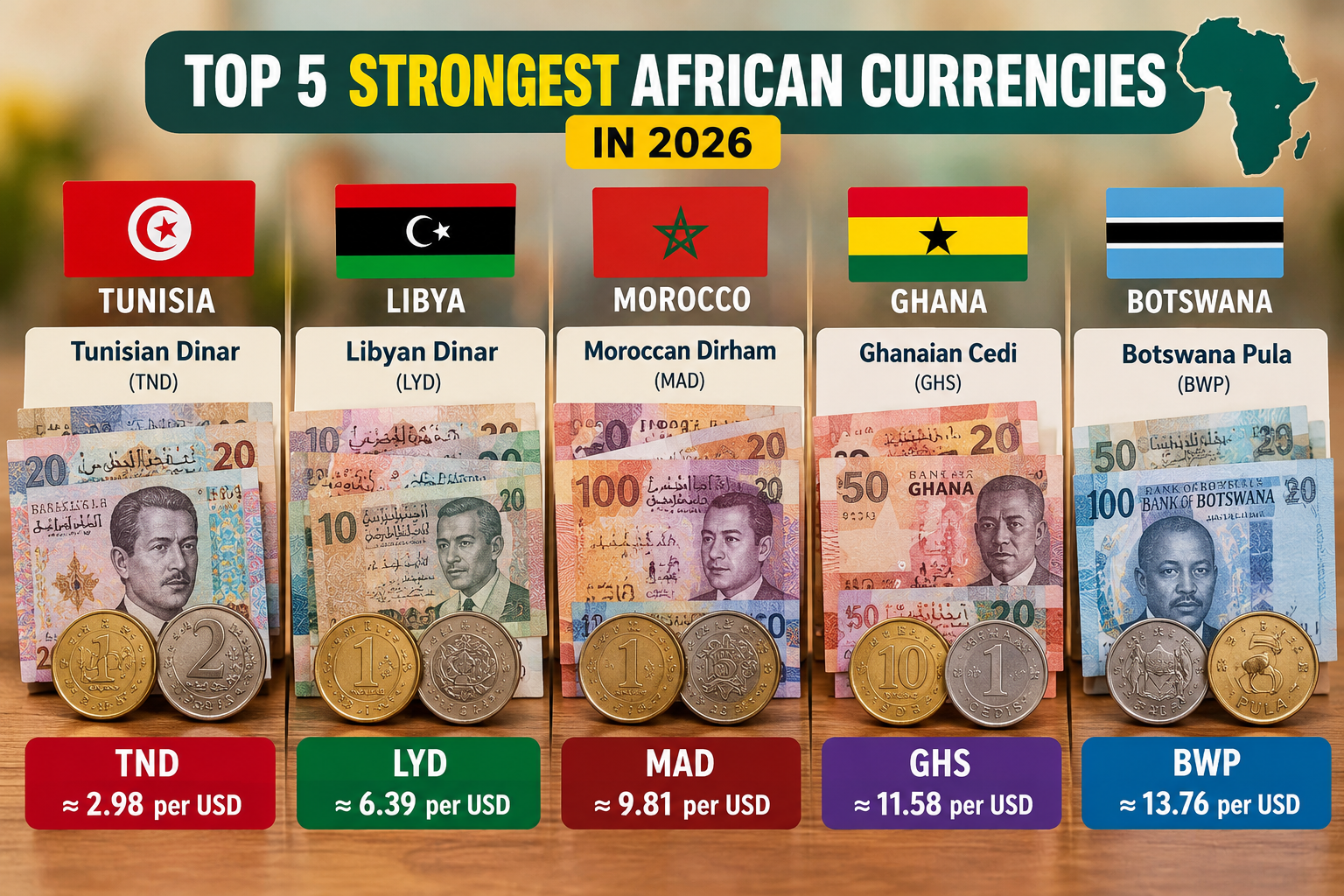
In 2026, Tunisia, Libya, Morocco, Ghana and Botswana stand out among the countries with relatively strong currencies against the dollar. Their positions offer an interesting picture of how different economic structures, government policies and natural resources influence the value of money across the continent.
However, the real story goes beyond which African currency exchanges for more dollars. It raises a bigger question: what exactly makes these currencies strong, and does that strength translate into better economic conditions for ordinary citizens?
Tunisia's Dinar remains at the top of the ranking, reflecting a currency supported partly by strict foreign exchange controls and efforts to manage inflation. The country's monetary authorities have maintained policies aimed at protecting the dinar's value, even as Tunisia faces political uncertainty, fiscal pressure and persistent economic challenges.
This presents an important distinction between currency strength and broader economic performance. A currency can retain a relatively high exchange value through government controls and monetary restrictions without necessarily reflecting a rapidly expanding economy or improved living conditions. Tunisia's position therefore demonstrates the importance of looking beyond exchange rates when assessing economic stability.
Libya's position tells a different story. The Libyan Dinar draws much of its strength from the country's enormous oil wealth. As a major oil producer, Libya generates substantial foreign exchange earnings from crude exports, providing an important source of support for its currency.
Yet, the country's experience also exposes the limitations of relying heavily on natural resources. Despite its oil wealth, years of political divisions, insecurity and institutional uncertainty have affected economic development. Libya's relatively strong currency does not erase these difficulties. Rather, it illustrates how access to valuable export resources can sustain a currency even when the wider economy faces serious structural problems.
Morocco offers a somewhat different model. The country's Dirham benefits from a more diversified economic base, with agriculture, tourism, manufacturing, mining and international trade contributing to economic activity. Its efforts to attract foreign investment, particularly in renewable energy, infrastructure and industrial development, have also strengthened its economic prospects.
Unlike economies that depend heavily on a single commodity, Morocco's diversified sources of revenue provide a broader foundation for financial stability. Its experience suggests that building a resilient economy requires more than generating foreign exchange; it also involves developing productive sectors capable of attracting investment, creating jobs and supporting long-term growth.
Ghana's Cedi presents one of the more complicated cases on the list. The currency has experienced significant volatility in recent years, driven by inflation, rising public debt, foreign exchange pressures and broader economic difficulties.
Recent reforms, including measures supported by the International Monetary Fund, have been designed to restore economic confidence, improve public finances and stabilise the currency. Government efforts to control inflation and manage debt are also central to the recovery process.
However, Ghana's experience shows how quickly currency gains can be undermined when economic fundamentals remain under pressure. A stronger exchange rate is encouraging, but maintaining that improvement requires sustained reforms, increased productivity, stronger exports and responsible management of public resources.
Botswana's Pula, meanwhile, reflects the benefits of relatively consistent economic management and institutional stability. The country has built a reputation for sound fiscal policies and comparatively strong governance, helping it maintain confidence in its financial system.
Diamonds remain a major contributor to Botswana's export earnings, but the country's long-term economic challenge is reducing its dependence on the mineral sector. Fluctuations in global diamond demand can affect export revenues, government income and foreign exchange availability. This makes economic diversification increasingly important to the continued strength of the Pula.

The Bigger Picture: A Strong Currency Does Not Always Mean a Strong Economy
Although these five countries occupy prominent positions in the ranking, their experiences demonstrate that currency strength can come from very different sources. Tunisia relies partly on exchange controls and inflation management, Libya benefits from oil revenues, Morocco draws support from economic diversification, Ghana is attempting to rebuild confidence through reforms, while Botswana's relative stability is linked to fiscal discipline and natural resource management.
There is also a need to distinguish between the nominal value of a currency and the actual purchasing power of the people who use it. The fact that one unit of the Tunisian Dinar or Libyan Dinar is worth more than one US dollar does not automatically mean that citizens in those countries are wealthier than Americans or enjoy a higher standard of living.
The exchange rate only shows how much of one currency can be exchanged for another. It does not independently measure household income, unemployment, poverty, inflation, access to essential services or the cost of living.
For instance, a country can maintain a relatively high currency value while its citizens struggle with unemployment, rising prices or limited economic opportunities. Equally, a country with a weaker currency can have a large and productive economy, strong export industries and considerable investment potential.
This is why the ranking should be understood as a comparison of exchange values rather than a definitive assessment of Africa's strongest economies.
Africa's Real Currency Challenge
For many African economies, the bigger challenge is not simply making their currencies worth more against the dollar, but creating the conditions that allow them to remain stable without excessive government intervention or dependence on a single export commodity.
Heavy reliance on imported goods, limited industrial production, weak export diversification, external debt and persistent inflation continue to expose several African currencies to pressure. When countries spend more foreign exchange on imports than they generate through exports and investment, their currencies can come under considerable strain.
Building stronger economies will therefore require governments to invest in local production, improve infrastructure, support businesses, strengthen public institutions and create an environment that attracts sustainable investment.
The experiences of Tunisia, Libya, Morocco, Ghana and Botswana offer different lessons, but they point towards one common reality: a currency cannot remain sustainably strong without a reasonably sound economic foundation.
Ultimately, Africa's financial progress should not be measured only by how many dollars its currencies can command. A more meaningful measure will be whether those currencies can maintain their value, protect citizens' purchasing power, encourage investment and support economic opportunities for the people who depend on them.



Comments (0)
No comments yet. Be the first to share your thoughts!