


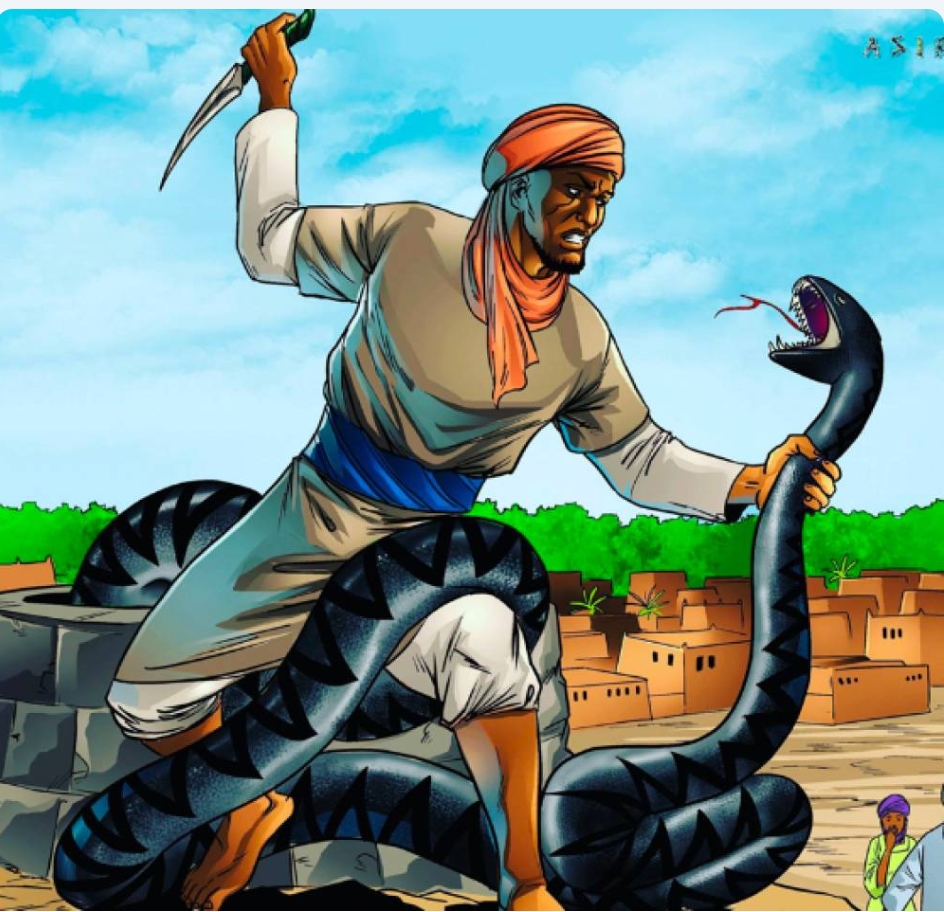
For over a millennium, the identity of the Hausa states has been anchored to a single, dramatic act of liberation. Folklore tells us of Daura, an ancient kingdom paralysed by terror. A monstrous snake named Sarki had taken residence in the Kusugu Well, denying the townspeople access to water except on Fridays. The community was utterly helpless, trapped in an existential stranglehold by an enemy it could neither placate nor defeat.
Then came Abu Yazid, popularly known as Bayajidda, the prince from Baghdad. Armed with a sword and a stranger’s courage, he slew the serpent, freed the water, and birthed a dynasty.
Today, a new and far more vicious serpent has emerged from the Rugu Forest, wrapping its coils tightly around Katsina State. This modern Sarki does not merely block access to water; it blocks access to farmlands, markets, schools, and life itself. It manifests in the form of armed banditry, mass kidnapping, and rural terrorism.
As a son of the soil, a great-grandson of Ummarun-Dallaje, the commissioned champion of Shehu Usman Bin Fodio for Katsina, I find myself viewing our current predicament through the lens of our oldest myth, compelled to ask an uncomfortable question: Are we merely waiting in the dust for a modern Bayajidda to ride in and save us, or have we forgotten that historical salvations are anomalies, not strategies?
The Coils of the Modern Serpent
The scale of the crisis engulfing Katsina defies the sanitised vocabulary of political press releases. Statistics paint a grim picture: between 2021 and 2025, more than 1,500 civilians reportedly lost their lives to banditry in the state, with fatalities rising sharply in recent years. Entire local government areas, including Batsari, Jibia, Safana, Kankara, and the recent kidnapping of General Rabe Abubakar in Matazu, have been transformed into operational playgrounds for criminal syndicates.
The response from authorities has mirrored the paralysis of ancient Daura before Bayajidda’s arrival. We have witnessed a carousel of failed strategies:
The Pacification Paradox: Repeated and fragile peace accords that treat warlords as diplomatic equals.
The Leverage Loop: Amnesty programmes in which millions are spent, only for criminal elements to use the respite to rearm, regroup, and strike with renewed ferocity.
The Sovereignty Vacuum: A glaring absence of state presence across vast borderlands, forcing desperate communities to enter informal non-aggression arrangements with terror leaders simply to survive.
Just as the people of ancient Daura waited until Friday to draw water, many rural communities now organise their lives around the whims of warlords. The state’s counter-insurgency architecture remains reactive, underfunded, and fundamentally detached from the daily realities of those on the frontlines.
The Illusion of the Stranger-Prince
The deeper danger of the Bayajidda myth is the psychology of dependency it can inspire. It teaches a traumatised population to look outward, toward a massive federal military deployment, an influx of foreign tactical support, or a miraculous political saviour, to slay the serpent.
But the battlefields of the 21st century do not yield to lone swordsmen. The asymmetric warfare ravaging the North-West is rooted in socio-economic failures, environmental degradation, weak governance, and fractured communal trust. No external saviour is coming to untangle these complexities overnight.
The state government’s regional peace initiatives may be welcome administrative measures, but frameworks alone do not defend a village at 2:00 a.m.
If Katsina is to be saved, the model of passive expectation must be abandoned. We must look beyond our borders to understand what happens when a community decides to become its own deliverer.
The Azare, Tafawa Balewa Blueprint: When Communities Refuse to Die as Cowards but as Heroes
We need not look to ancient history for a model of resistance; we need only look eastward to Bauchi State. During the height of the Boko Haram insurgency, when the terror group sought to expand its footprint across the North-East and into parts of North-Central Nigeria, some communities demonstrated remarkable resilience. Among them were Azare and Tafawa Balewa communities.
While other towns buckled under the weight of fear, the people of Azare and Tafawa Balewa forged a collective resolve. They built a localised fortress of resistance founded on three key pillars:
Absolute Communal Trust: The dismantling of ethnic and religious barriers to ensure seamless information-sharing and collective vigilance.
Local Vigilance and Ownership: The integration of traditional hunters, Yan Baka, and youth vigilante groups, Yan Banga, into community security efforts, working in close coordination with state authorities.
Ideological Rejection: A firm refusal by religious and traditional leaders to excuse, sanitise, or negotiate away the crimes of insurgents.
Azare and Tafawa Balewa endured because their people recognised that state institutions were too distant to provide immediate protection. They refused to wait for a prince from Baghdad. They organised, protected their communities, secured their perimeters, and aggressively exposed internal collaborators.
This approach was endorsed by the current D.G. of DSS, Adeola Oluwatosin Ajayi, narrating his experience while serving as State D.G. of Bauchi DSS.
He also quoted former Head of State, General Ibrahim Badamasi Babangida, thus:
"If we want to end or curb terrorism we must emulate Azare example"
Slaying the Serpent from Within
The historic Kusugu Well still stands in Daura, a quiet monument to a bygone era of heroism. Yet history is meant to be a teacher, not a security blueprint.
Katsina cannot afford to wait for a mythical figure to rescue it from its present nightmare. The Bayajidda we seek is not an individual; it is a collective consciousness. It is the urgent and radical reorganisation of our community defence structures. It means transforming local vigilante groups from poorly equipped sacrificial lambs into highly trained, adequately funded civilian joint task forces supported by robust intelligence networks.
It requires our traditional institutions to cease acting as helpless observers and instead become the administrative anchors of local security, relentlessly identifying and isolating informants and collaborators within our communities.
The snake is already inside our well. It is draining our lifeblood, destroying our future, and mocking our heritage. If we remain on our knees, waiting for an external saviour, we risk inheriting nothing but a graveyard of a state.
The lesson of Azare and Tafawa Balewa is clear, and the mandate of history is urgent: we must rise, look the monster in the eye, and wield the sword ourselves.
Ibrahim Babangida Lawal
abumaimoonahweb@gmail.com
2 June 2026
Chairman, Kungiyar Katsinawa Mazauna Gwagwalada, Abuja.



Comments (0)
No comments yet. Be the first to share your thoughts!